
Comparison
Kneeling Chair vs Saddle Stool: Pick by Where the Pressure Goes
Kneeling chair vs saddle stool for posture: how each opens the hip angle, where the pressure lands, a side-by-side table, and which fits your desk and day.
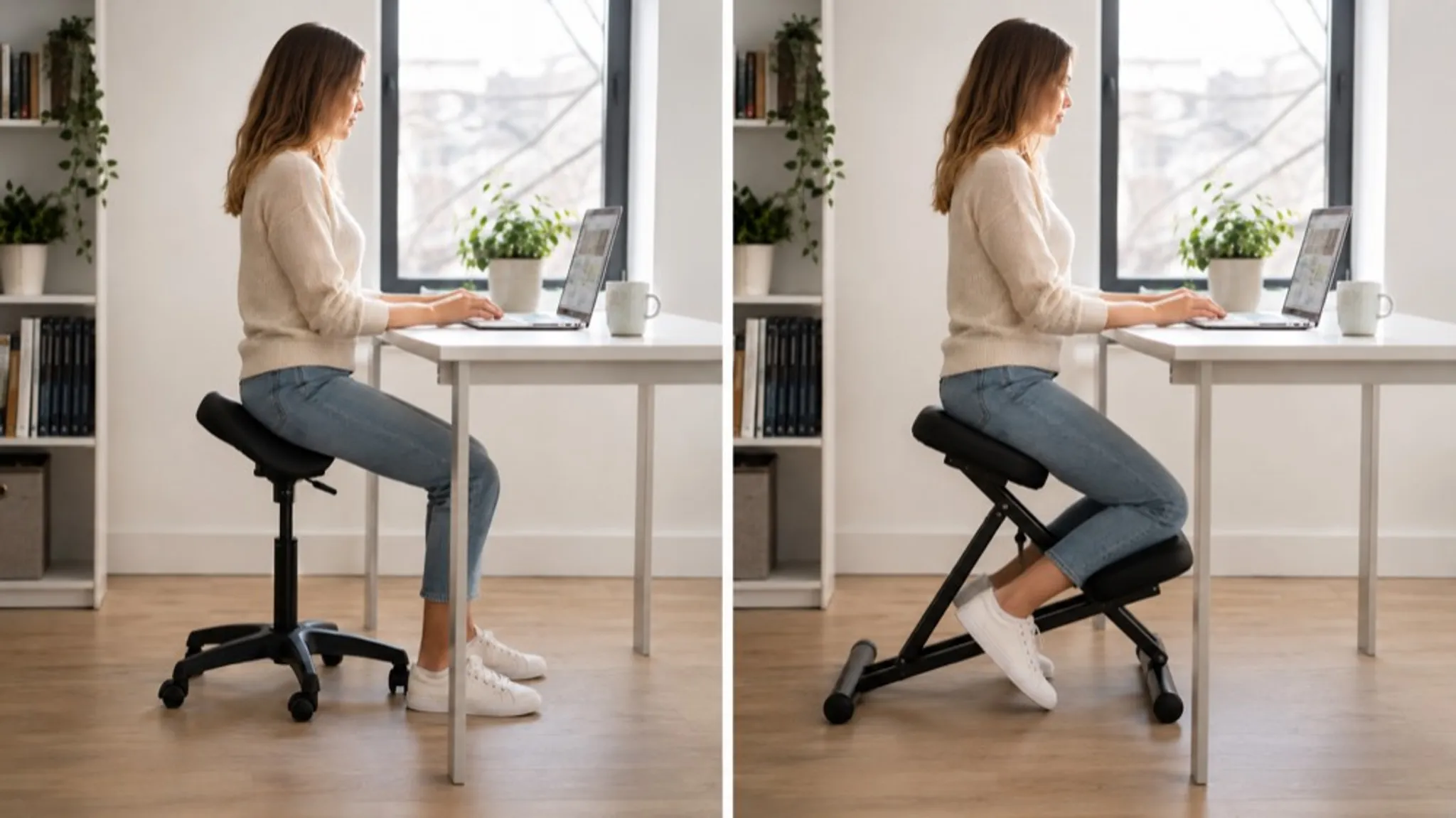
Strip both seats down to the mechanism and they are doing the same job: rotating your pelvis forward so your lower spine can hold its natural curve. What separates a kneeling chair from a saddle stool is where the bill lands. One charges your shins and knees. The other charges your sit bones and usually asks for a taller desk.
Below: how each seat creates its posture, what a week of real use feels like, which desk each one needs, and the gap neither of them covers.
How does a kneeling chair work?
A kneeling chair removes the front lip of a normal seat and adds an angled shin pad. You perch on a downward-sloping seat with your weight split between your seat bones and your shins. That forward slope opens the angle between your thighs and your torso, well past the 90 degrees a standard chair forces on you.
Opening that hip angle is the whole idea, and it has old evidence behind it. Keegan's radiographic studies (The Journal of Bone and Joint Surgery, 1953) pegged the lumbar-friendly trunk-thigh angle at roughly 135 degrees; at 90 degrees the pelvis tips backward and the curve gives way. A wider angle tips your pelvis forward, which makes it easier for your lower spine to keep its inward curve instead of rounding into a slump. For a lot of people, that feels like the lower back finally has somewhere to go.
The catch is where the pressure lands. Some of your body weight moves off your seat bones and onto your shins and knees. For short, focused stretches that is fine. Over a full day it can become the thing you notice most.
How does a saddle stool work?
A saddle stool solves the same posture problem from a different direction. Instead of a flat pad, you sit on a seat shaped like a horse saddle, with a raised front and a dip in the middle. You straddle it, so your legs drop down and slightly apart, and your feet stay flat on the floor.
That straddled position rolls your pelvis forward and drops your knees below your hips, which opens the same hip angle a kneeling chair chases, but without putting weight on your shins. Your spine tends to stack up more naturally over your pelvis. This is why saddle stools are common in dentistry, dental hygiene, and other trades where people lean in close for hours.
Saddle stools sit higher than a normal chair. To keep your forearms level with your work you often need a taller desk or a sit-stand desk raised part way up. That is the single most common surprise for first-time buyers.
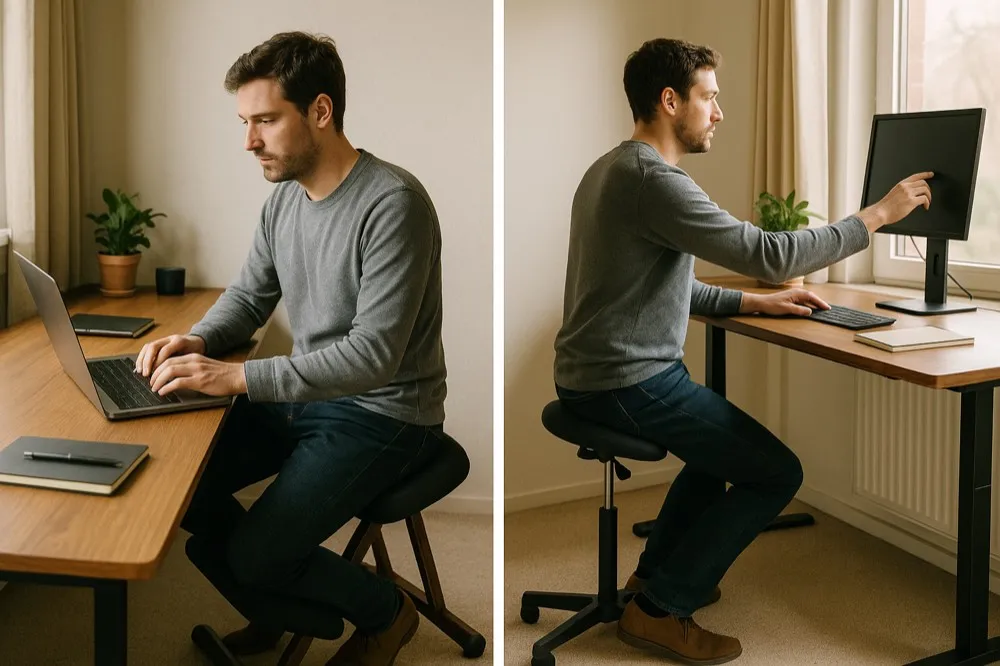
Kneeling chair vs saddle stool: side-by-side comparison
Here is how the two concepts stack up on the things that actually matter over a working week.
| Factor | Kneeling chair | Saddle stool |
|---|---|---|
| Posture mechanism | Forward seat slope opens the hip angle | Straddled saddle seat tips the pelvis forward |
| Back support | None | None |
| Weight distribution | Shared between seat bones and shins | On the seat bones, feet flat on the floor |
| Long-day comfort | Shin and knee pressure builds over hours | Better for long sessions, but sit-bone or perineal pressure can appear |
| Freedom to move | Restricted; legs are tucked and pinned | Good; legs are free, easy to shift and reach |
| Getting in and out | Awkward; you climb in and out | Easy; you step over and sit |
| Desk height needed | Works with a standard desk | Usually needs a taller or raised desk |
| Learning curve | Short, but shin tolerance takes days | A week or two to adjust to the straddle |
| Best for | Short, focused work blocks | Task work that needs reach and movement |
Which one is better for your lower back?
Both open the hip angle, and for the lower back that is the point. Mandal's work on the seated posture (Applied Ergonomics, 1981) argued that the 90 degree sit is a furniture convention, not an anatomical one, and that a working posture should drift toward half-standing, hips open at roughly 120 to 135 degrees. Each of these seats is a serious attempt to act on that finding, and neither is clearly superior on spinal position alone. What separates them is what your body has to tolerate to hold the position.
A kneeling chair asks your shins and knees to carry part of the load. If you have sensitive knees, past knee injuries, or you simply want to stand up often, that pressure becomes a limiter. Many owners report their kneeling chair is excellent for an hour of deep focus and much less pleasant by mid-afternoon.
The saddle stool keeps your feet on the floor and your legs free, so there is no shin pressure at all. In exchange, the narrow saddle can create pressure on the sit bones or the soft tissue between them, especially before your body adjusts. Padding and seat width help, but it is a real acclimation period, not a myth. Commonly cited ergonomics guidance keeps coming back to the same theme: no single fixed posture is healthy for eight hours, and the best seat is one that lets you keep changing position. That is worth holding onto as you choose.
Which one suits your workday?
Think less about which chair is "correct" and more about how you actually spend your hours.
Choose a kneeling chair if you work in defined blocks, you want a low-cost way to break a deep-slouch habit, your desk is a normal height, and you are happy to stand or switch chairs when your shins have had enough. It is a strong tool for short, intense sessions and a poor one for a marathon.
Pick a saddle stool if you lean toward your work, reach around a lot, want to get up and sit down easily, and you either have a tall desk or a sit-stand desk you can raise. It rewards people who move and stay active on the seat. It punishes people who expect to sink back and relax, because there is nothing to sink back into.
Two groups should tread carefully with both. If you are shorter than about 5 foot 4 or taller than about 6 foot 2, fit matters more than the concept, and many of these seats are not built for the ends of that range. And if your job involves long calls, reading, or anything where you naturally want to lean back and think, a backless posture seat will fight you all day.
The gap they both leave open
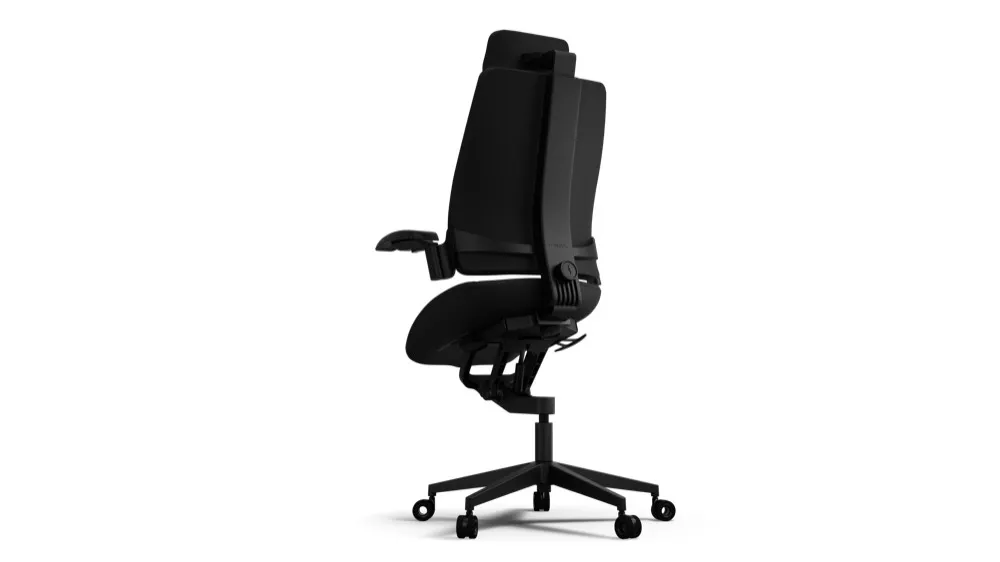
Step back and you can see the pattern. A kneeling chair and a saddle stool are both good at one thing: putting you into a forward, open-hip working posture. Neither gives your back anything to rest against, and neither carries you gracefully when you shift out of that forward position to recline, take a call, or simply relax for ten minutes.
This is the quiet failure across nearly all posture seating. It holds one position and abandons you the moment you move. That is exactly why so many people end up owning a kneeling chair and a task chair and a stool, rotating through them because no single one covers the full day. You buy three partial answers instead of one complete one.
To weigh either option on its own, see our full breakdowns of whether kneeling chairs are good for your back and whether saddle chairs are good for your back. For the full landscape of every posture seat and how they relate, start with our guide to alternative seating and the chairs that fix your posture. And if you have already ruled the kneeling chair out, the best kneeling chair alternative for all-day desk work covers what to try next.
The chair that keeps the angle when you move
Both seats earn their keep by opening the hip angle, and both make you pay for it somewhere: the kneeling chair on your shins, the saddle by straddling. Changing the seat itself is a third route.
The Vision Chair opens the angle the same way a saddle does, by sloping the seat, up to 18 degrees forward of flat. What it adds is a backrest linked to that seat, so the two move together and the open angle holds across the chair's range instead of only while you hold yourself in it. The patent-pending T-Mech™ carries the seat along a knee-centred arc, so your thighs stay supported rather than your shins taking the load. A shaped foam bowl cradles the pelvis the way a saddle tries to.
The slope does the same self-correcting work a saddle does, too. Perch too far forward and you slide; let your pelvis roll back and it feels wrong straight away. You find out in seconds instead of at the end of the day. The difference is that here there is a backrest waiting when your muscles are done, and no pressure on your shins or between your legs.
One setup consequence: the slope raises how high you sit, so it wants a desk that can rise to match. Saddle stools ask the same thing, so if you were already considering one, you have already accepted that trade.
It sits in the premium tier rather than the budget one, and it took home the Best of NeoCon 2026 Innovation Award in Chicago. If you have been rotating through partial solutions and want one seat that moves with you, see the Vision Chair at the Vision Chair.
Frequently asked questions
Is a kneeling chair or a saddle stool better for lower back pain?
Both open the hip angle and can reduce slouch, so neither is clearly better on spine position alone. The deciding factor is tolerance: kneeling chairs load your shins, saddle stools can pressure the sit bones. Pick the discomfort your body handles best, and change position often.
Can I use either one as my only chair for eight hours?
Most people find that hard. Neither offers back support, so long days get fatiguing. A saddle stool tends to last longer in a single sitting than a kneeling chair, but both are better used in focused blocks and paired with standing or a supportive chair.
Do saddle stools require a special desk?
Often, yes. Saddle stools sit higher than standard chairs, so a normal desk can leave your arms reaching down. A taller desk or a sit-stand desk raised part way up keeps your forearms level with your work. Check your desk height before buying.
Which is easier to get used to?
A kneeling chair feels natural within minutes, though your shins need a few days to adjust. A saddle stool takes a week or two before the straddled position feels normal. Neither has a steep learning curve, but both reward easing in gradually rather than switching cold for a full day.