
Buying Guide
Are Saddle Chairs Good for Your Back? What the Forward Tilt Fixes and What It Asks of You
Saddle chairs open the hip angle and tip the pelvis toward a neutral spine. See who they suit, the sit-bone and no-backrest trade-offs, and what lasts.
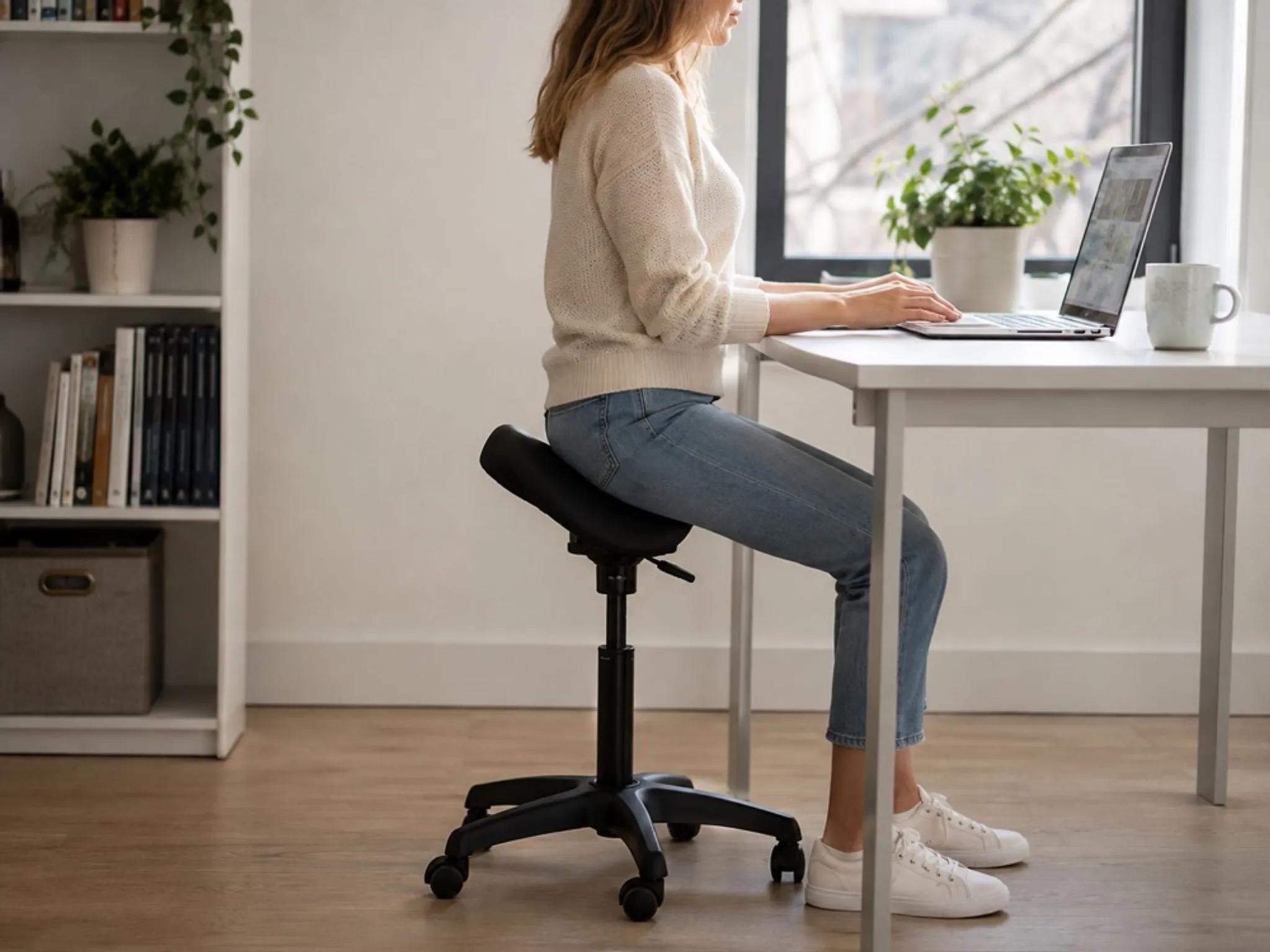
Dentists worked this out decades ago. Watch a hygienist lean over a patient for an hour and you will find a saddle stool underneath, not a plush task chair, because a saddle lets you tilt forward from the pelvis instead of hunching from the spine. If it keeps clinicians upright through a full shift of close work, the thinking goes, it should straighten out a desk slouch too.
Partly, it does. A saddle chair changes something real about how your spine sits, and it also asks something of your body that not everyone wants to give. What follows: how the straddle position changes your posture, who it serves best, how the first month actually feels, and where the missing backrest catches up with you.
How does a saddle chair change your posture?
A saddle chair is shaped like a horse-riding saddle. Instead of sitting with your thighs roughly parallel to the floor, you straddle the seat and your legs drop down and slightly out to the sides. That single change does most of the work.
When your thighs angle downward, your hip angle opens well past the usual 90 degrees. A wider hip angle tips your pelvis forward into a slight anterior tilt, and that forward tilt is the key. It lets your lumbar spine settle into its natural inward curve instead of flattening or rounding backward, which is what happens when most people slump in a standard chair.
The research behind this is older than most office furniture. Keegan's radiographic studies (The Journal of Bone and Joint Surgery, 1953) placed the best trunk-thigh angle for holding the lumbar curve at roughly 135 degrees; drop to 90 and the pelvis rolls back, taking the curve with it. A saddle seat moves you toward that open angle without you having to think about it. You also tend to sit taller, because there is nothing to lean back into, so your core and back extensors stay lightly engaged. For anyone who spends the day collapsing into a soft chair, that is a real improvement.
Who gets the most out of a saddle chair?
Saddle chairs are not a gimmick. They earned their reputation in dentistry, hygiene, surgery, and lab work, and there is a reason.
- Clinicians who lean over patients. Dentists, dental hygienists, and surgeons need to get close to a mouth or a field without hunching. A saddle seat raises the hips and lets the practitioner tilt forward from the pelvis rather than the spine.
- People who pair it with a higher desk. A saddle chair sits taller than a normal task chair. It shines when your work surface is raised or your desk is height-adjustable, so your forearms still land at the right level.
- Active sitters who dislike being pinned in place. With no armrests or back to trap you, a saddle chair makes it easy to rock, swivel, and reach. If you fidget, that freedom feels good.
- Short, focused work blocks. For an hour of detailed close work, a saddle chair keeps you upright and alert in a way a plush chair never will.
If you fall into one of those groups, a saddle chair may be one of the better posture tools you can buy for the price.
How does the first month on a saddle chair go?
The first days are an adjustment, and the reviews that call saddle chairs uncomfortable are not wrong.
Your body puts weight on the two sit bones (the ischial tuberosities) and, on a saddle seat, on the soft tissue between them. Until the surrounding muscles adapt, that pressure can feel sharp. Split-seat saddle designs relieve the central pressure but can shift it to the inner thighs instead. Most people who stick with it report the discomfort easing over two to four weeks as the tissue and muscles acclimate. Some never fully make peace with it.
There is a second, subtler issue that shows up over weeks, not days. Most saddle chairs are backless. Backed versions do exist, though the backrest is usually small and set low, and leaning into it works against the forward-tipped posture the saddle is creating, so in practice you are still holding yourself up. Early in the day, staying upright feels effortless and even energizing. By mid-afternoon, when your postural muscles fatigue, there is nothing to catch you. You start to slump forward or perch on the edge, and the very posture the chair was meant to protect quietly erodes. The chair does not hold the position for you. It only makes the position available while your muscles have the stamina to hold it themselves.
That is the core tension with saddle seating. It is a posture prompt, not a posture support.
What are the real drawbacks of a saddle chair?
No back support is the headline, but there are a few more trade-offs worth naming before you buy.
- No backrest. You cannot recline, decompress, or rest your spine against anything. Over an eight-hour day, that becomes fatiguing.
- Sit-bone and perineal pressure. Solid saddles can create pressure through the pelvic floor. Split designs help but do not fully solve it, and the fit is personal.
- A real learning curve. Expect two to four weeks before it feels normal, and accept that for some bodies it never does.
- It usually needs a taller desk. A saddle chair raises you up. On a fixed low desk your arms end up too high, which trades a back problem for a shoulder-and-wrist problem.
- Clothing and getting on and off. The straddle position is less graceful than lowering into a normal chair, and some people simply find it awkward in an open office.
None of these make the saddle chair a bad product. They make it a specialized one. It rewards active, upright, shorter sessions and punishes the long, tired, lean-back hours that make up a normal workday for most desk workers.
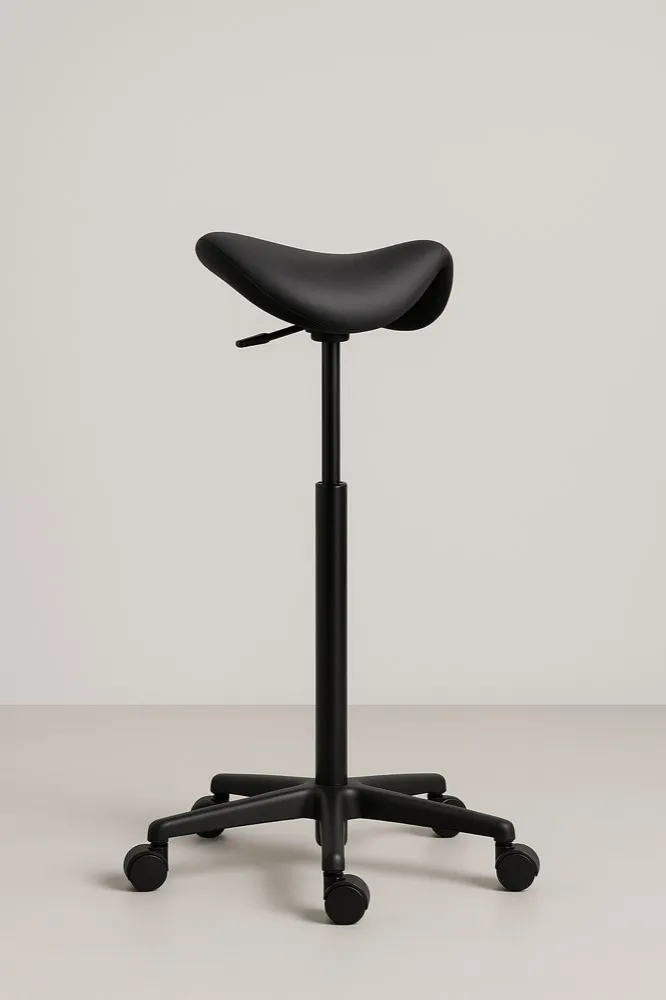
Are saddle chairs good for lower-back pain specifically?
For some people with lower-back pain, yes, especially pain that gets worse from slouching and prolonged flexion. By opening the hip angle and restoring the lumbar curve, a saddle seat can take pressure off the structures that a rounded-back posture aggravates. Mandal made the underlying case in Applied Ergonomics (1981): sitting at 90 degrees was decided by furniture makers, not by the body, and the seated worker belongs closer to half-standing, hips open around 120 to 135 degrees. A saddle seat is one of the few affordable ways to get there.
It is not a universal fix, though. If your pain flares from prolonged upright loading, or if you need to change positions and rest your back through the day, a backless chair, or one whose backrest is too small to lean on properly, can make a long day harder, not easier. The forward-tilt principle is sound. Relying on your own muscles to sustain it for eight hours is the part that fails. If you are weighing this against other options, our comparison of a saddle chair versus a kneeling chair breaks down which forward-tilt approach fits which body and desk.
Saddle chair scorecard
| What matters | How a saddle chair does |
|---|---|
| Opens hip angle / neutral pelvis | Strong. This is its whole point. |
| Encourages an upright spine | Strong, while your muscles are fresh. |
| Back support | None. No backrest at all. |
| All-day comfort | Weak. Fatigue and sit-bone pressure build. |
| Freedom to move | Strong. Nothing pins you in place. |
| Learning curve | Moderate. Two to four weeks typical. |
| Best use | Short, active, close-up work at a raised desk. |
Frequently asked questions
Are saddle chairs better than regular office chairs for your back?
For active, upright, close-up work, a saddle chair often produces a healthier pelvis and spine position than a slouched regular chair. For long days where you need to recline and rest your back, a supportive chair with a backrest usually serves you better. It depends on your work, not just the chair.
How long does it take to get used to a saddle chair?
Most people report two to four weeks. The sit-bone pressure eases as the surrounding tissue and muscles adapt, and staying upright starts to feel natural rather than effortful. If you are still in real discomfort after a month, the fit or seat style may be wrong for you.
Do I need a special desk for a saddle chair?
Usually yes, or at least a taller one. A saddle chair raises your hips, so a standard low desk can leave your arms too high. A height-adjustable or drafting-height desk lets you keep your forearms level while enjoying the open hip angle.
Can a saddle chair cause pain?
It can, mostly sit-bone or perineal pressure during the break-in period, and lower-back fatigue late in the day, because most saddle chairs give you nothing to lean on and the backed versions offer little. Choosing a split-seat design and limiting your longest sessions helps. If pain persists past the adjustment weeks, reconsider the fit.
The open angle, held for you
A saddle stool opens the hip angle by shaping the seat and letting you straddle it. It works, and it holds only as long as your postural muscles do; when they tire there is usually nothing to lean into.
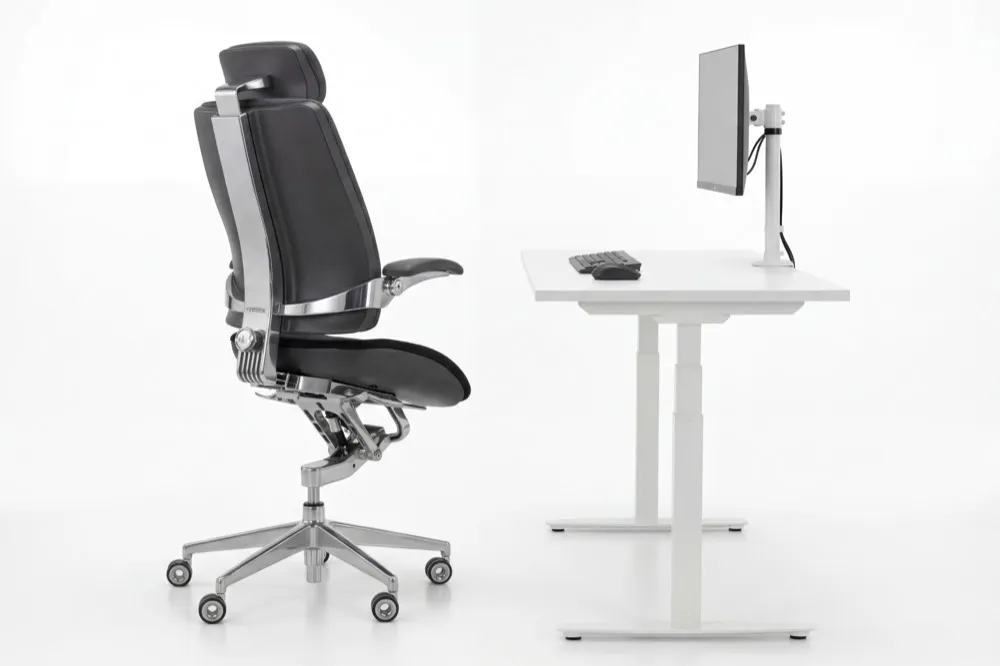
The Vision Chair opens the same angle by sloping the seat instead, up to 18 degrees forward of flat, which tips the pelvis forward and lets the lumbar curve return on its own. The difference is what happens next. The backrest is linked to the seat and travels with it, so the open angle is held by the chair rather than by you, and there is a real backrest behind you when your muscles clock out. The patent-pending T-Mech™ pivots the seat around the knee so support under your thighs stays put through the range.
The useful part a saddle already teaches you: a sloped seat is self-correcting. Sit too far forward and you slide, roll your pelvis back and it feels wrong immediately. The good position is the comfortable one, so you settle into it without deciding to. That is as true here as on a saddle, with the fatigue problem solved rather than endured.
It asks the same thing of your desk that a saddle stool does, since the slope raises your seated height. The design won a Best of NeoCon 2026 Innovation Award.
There is a setup cost either way. A saddle stool sits you high and usually needs a taller desk to match; the same is true here, since the forward seat angle raises your seated height. A height-adjustable desk is what makes either work properly.
If a saddle stool is not quite carrying you through a full day, it is worth seeing how a saddle chair stacks up in the best saddle chair alternative for all-day work, or reading the wider guide to alternative and posture seating to place it against every other option. You can also compare it with the Capisco-style saddle sit-stand approach, or see the Vision Chair itself at the Vision Chair.