
Elevated Seating
Elevated Seating: The Comfort of Sitting, the Posture of Standing
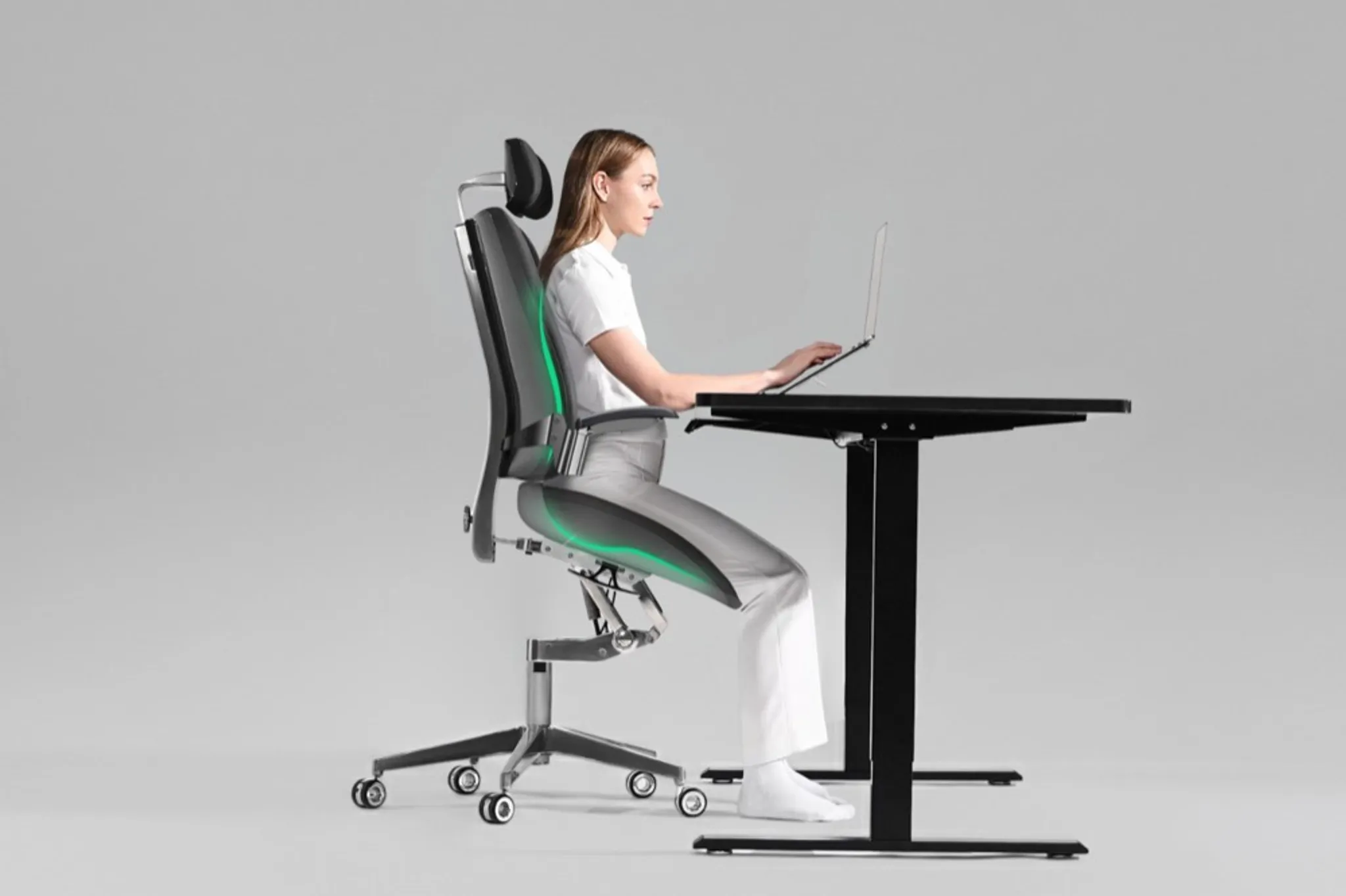
Elevated Seating angles the seat forward so your hips open toward where they sit when standing, while the chair carries your weight. A posture between sitting and standing, nearer to sitting, holding the hip angle between roughly 115 and 125 degrees at all times.
Most desk work comes down to a choice you keep making all day. Sit, and after an hour or two you want to be up. Stand, and before long your legs want you back down. So you alternate between the two, and neither one stays comfortable for as long as you need it to.
Elevated Seating is desk seating that angles the seat forward so your hips open toward where they sit when you are standing, while the chair still carries your weight. The posture lands between the two, nearer to sitting than to standing, and that is the point: you get something of what standing does for your back without asking your legs to hold you up. Levitask created the category. The Vision Chair is the first chair built for it.
The part worth understanding is where the good posture comes from. On a conventional chair, the natural S-curve of your spine is imposed on you from behind, by a lumbar pad pushing into your lower back. Here it is produced by the geometry you are sitting on. Angling the seat forward tips your pelvis forward, and the S-curve returns on its own, because that is the shape a forward-tipped pelvis puts your spine in. Nothing has to push you into it.
The name exists because the old names stopped being precise. "Ergonomic chair" promises everything and specifies nothing. "Standing desk chair" describes where the furniture stands rather than what it does. "Alternative seating" is a shrug that covers a dozen unrelated ideas. Elevated Seating describes something narrower and more literal: the seat tilts, so you sit higher.
What actually happens
Start from an ordinary chair. Flat seat, upright back, hips closed to about 90 degrees. In that position the pelvis rolls backward, which flattens the inward curve of the lower spine. It is why conventional chairs need a lumbar pad: something has to hold the curve that the seating position has just taken away.
Now tilt the seat forward. Your thighs slope down, your pelvis tips forward instead of tucking under, and the angle between your torso and your thighs opens. The lumbar curve comes back as a consequence of that, not as something pressed into you. Tilt far enough and you are no longer sitting in the way a conventional chair means it. You are somewhere between sitting and standing.
The Vision Chair's seat angles up to 18 degrees forward of flat, and the backrest travels with it rather than staying put. At full incline the backrest sits roughly upright, which already puts the angle between your torso and thighs at about 115 degrees, twenty-five more than an ordinary chair gives you.
From there the backrest adds its own movement. A spring lets it recline a further five to ten degrees as you lean into it, and it can be locked at its most upright position if you would rather it stayed put. So the open angle runs between roughly 115 and 125 degrees, and it is in that band at all times.
Note what the lock does and does not do. It holds the backrest at the upright end of its spring travel; it does not pin the backrest relative to the seat. Flatten the seat angle and the backrest still leans back with it, because the two are linked. That is the mechanism working as intended rather than a limitation of the lock.
That last part is the whole idea, and it is the opposite of what most chairs do. On a conventional chair your body angle is a consequence of how you happen to be sitting: recline and it opens, lean toward the desk and it shuts back to 90 or tighter. Here the seat and backrest move together, so leaning in to work does not close you up. The angle stays in its band whatever you are doing.
That is what Levitask means when it says the angle never closes, and it is worth being precise about the scope. It describes the chair, not your spine. You can still sit bolt upright or perch on the front edge if you want to; no chair prevents that. The claim is that the chair's own movement does not close you up, so the open angle is not something you have to keep restoring.
What makes that stick in practice is less about geometry than feedback. On a flat seat you can sit badly for hours and never notice, because the chair is equally content holding you in a slump. A sloped seat is not so accommodating. Perch too far forward and you begin to slide. Let your pelvis roll back and the position simply feels wrong, because the seat is no longer under you the way it was. You find out in seconds rather than at six in the evening.
And the good position is the comfortable one, which is the part that matters. Sitting open on an angled seat is not a discipline you maintain. It is the path of least resistance, so holding it costs no attention at all.
The second thing the incline does is less obvious and matters just as much: it raises you. A seat tilted forward sits you higher than the same seat flat. That single fact shapes the whole setup.
It pairs with a height-adjustable desk
This is the part to know before you buy anything.
A standard desk is about 73cm. That height was settled on for people sitting flat, at 90 degrees. Once the seat is angled and you are sitting higher, a fixed 73cm desk is too low, and you end up reaching down to it, which undoes the posture the angle just gave you.
So Elevated Seating is a two-part setup. The chair sets your angle, and the desk rises to meet it. Change the angle during the day and the desk height changes with it. That is not a workaround, it is how the system is meant to run, and it is why Levitask shows the chair with a height-adjustable desk rather than on its own.
There is a middle option if a new desk is not on the cards. The devices that sit on top of an existing desk and raise a keyboard and laptop will get you most of the way, since what actually matters is the height of the work surface relative to you, not what is holding it up. It is less tidy than a desk that moves as one piece, and you are managing two surfaces instead of one, but it works.
What does not work is leaving a fixed 73cm desk as it is and hoping the chair compensates. Better to know that before you order than after. There is more on pairing the two in A Height-Adjustable Desk Needs a Seating Strategy.
Why the incline does not simply slide you off
Tilting a seat forward is easy. Staying on it is the hard part, and it is where most open-angle seating spends its ingenuity.
A plain forward-tilting seat sends you toward the front edge, so you brace with your legs to hold position, and bracing all day is its own kind of tiring. The established answers each solve the slide by putting the load somewhere else. A kneeling chair takes it on your shins. A saddle stool has you straddle the seat. A perch stool leans you against a high, narrow pad. All three open the hip angle, and all three ask something of your body in exchange, which is why most people use them in stretches rather than for a full day.
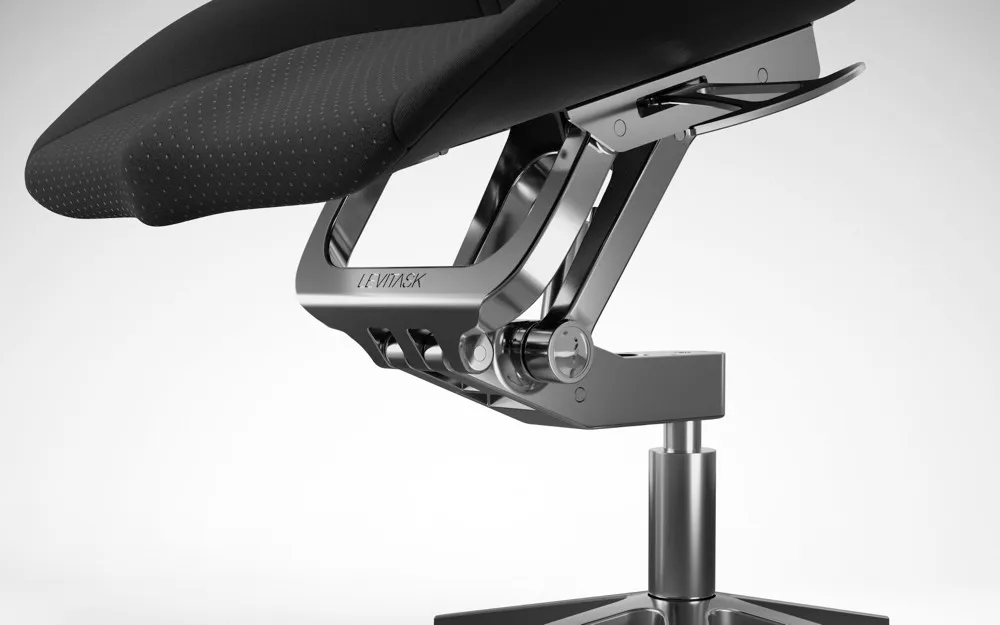
Levitask's answer is geometric rather than postural. The patent-pending T-Mech™ swings the seat along an arc whose pivot sits at your knee, so as the angle changes the seat stays under your thighs instead of tipping out from beneath them. You are supported by the seat rather than held on it by your legs. That is the difference between an angle you can adopt and an angle you can work in from morning to evening.
The seat surface does part of the work too. An anti-slip matrix of fine rubber dots across the seat adds enough grip to stop the small creeping slide that a tilted surface would otherwise produce. It is a modest detail next to the linkage, and it is the kind of thing you only notice by its absence.
Why an open angle is worth the trouble
The idea is much older than the label. Mandal's work on the seated worker (Applied Ergonomics, 1981) argued that the 90 degree sitting posture is a product of furniture design rather than anatomy, and that a working posture is better served by something closer to half standing, with a hip angle around 120 to 135 degrees. That is a fair description of what an angled seat produces.
Keegan's earlier radiographic study of the lumbar curve (The Journal of Bone and Joint Surgery, 1953) pointed the same way, putting the angle that best preserved the natural curve of the lower spine at roughly 135 degrees, and finding that at 90 degrees the pelvis rotates back and the curve flattens.
None of that means a chair fixes anything. It means the right angle most chairs are built around is a convention rather than a requirement, and that opening it has a long history in the seating literature.
Using the range
The seat runs from flat to 18 degrees, and the two ends of that range are two different ways of working rather than better and worse versions of the same one.
At the steep end you are up and forward, close to standing, weight carried through an open hip angle with the backrest roughly upright behind you. This is the end for concentrated work. It is also the end that asks a little more of you, in the way standing does.
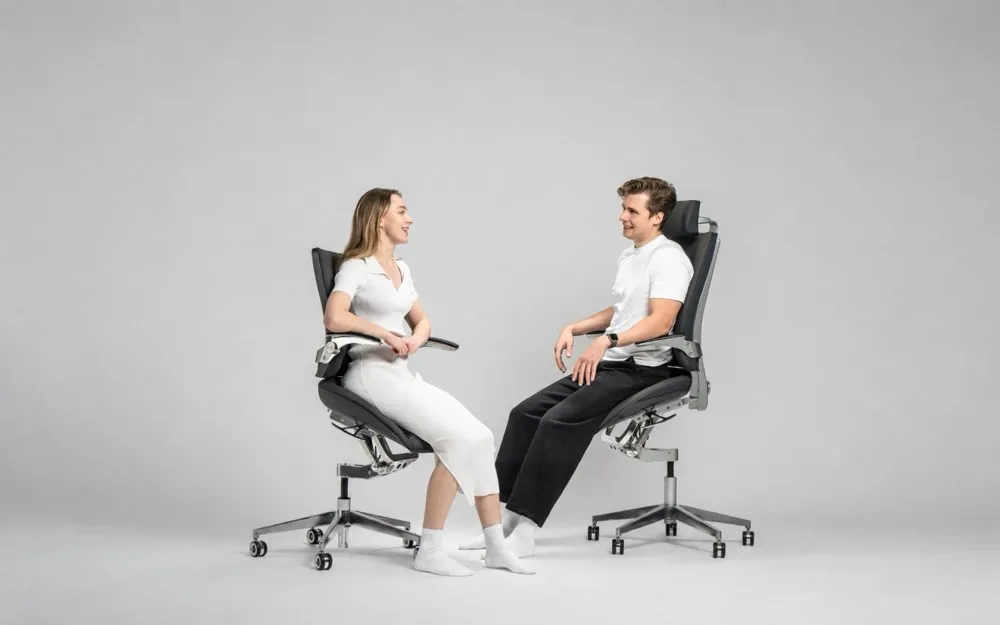
At the flat end the backrest has travelled back with the seat, so you are reclined rather than square. This is the resting end: still open at the hip, but with the chair taking more of your weight and your body angled back. Good for calls, reading, thinking, and the stretch of the afternoon when the steep end stops being appealing.
That is the useful thing to understand. You are not choosing how open your hips are, because the linkage holds that open throughout. You are choosing how upright and how high you sit, and how much of the work the chair does for you.
From there it is a matter of preference. Some people move through the range across a day, starting steep while fresh and easing back as it goes on. Others find one setting they like and leave it. Both are fine; the range exists so you can choose, not so you have to keep choosing.
Whichever you do, move the desk with the chair. That is the habit worth building.
Is it right for you?
It suits people who work long days at a desk they can raise and lower, who have noticed their current chair only feels good while they sit still, and who would rather change posture than change furniture.
It suits people who have tried the open-angle alternatives and liked the posture but not the price their shins or their legs paid for it.
Two things it is not. It is not a chair that demands constant fiddling: plenty of people find one setting they like, leave it there, and never touch the lever again. And it is not a chair that only rewards long days. It is comfortable for an hour or for eight, the same as any good chair should be.
The one real constraint is the desk. If your work surface height is fixed and staying that way, and a keyboard riser is not an option either, the geometry cannot do what it is meant to do. That is worth knowing before you order rather than after.
For a fuller comparison of what else is out there, see the complete guide to alternative seating. For why "ergonomic" has stopped being a useful filter when you shop, see Why "Ergonomic" Has Become Too Vague.
Frequently asked questions
What is Elevated Seating?
Desk seating that angles the seat forward so you sit higher and more open, in a posture between sitting and standing, with your weight still supported by the chair. Levitask created the category and the Vision Chair is the first chair built for it.
How is it different from an ergonomic chair?
A conventional ergonomic chair is built around one upright position, roughly 90 degrees at the hip, with adjustments to help you reach it. Elevated Seating changes the position itself by tilting the seat, which opens the hip angle and raises your seated height.
What does "the angle never closes" mean?
It describes the chair rather than the sitter. The seat and backrest move together, so across the chair's range the angle between your torso and thighs stays between roughly 115 and 125 degrees, where an ordinary chair shuts back toward 90 as you lean in to work. You can still sit upright or perch forward by choice. The point is that the chair is not what closes you up, and that the open position is the comfortable one, so you tend to stay in it without trying.
Do I need a special desk?
You need a work surface that can change height. A height-adjustable desk is the cleanest way to do it, because the whole surface moves as one. A riser that lifts your keyboard and laptop on top of an existing desk also works, since what matters is where the work sits relative to you. What does not work is a fixed 73cm desk left as it is, because the incline raises how high you sit and you end up reaching down to meet it.
What does the backrest lock do?
It holds the backrest at the most upright end of its spring travel, for when you would rather it did not give as you lean back. It does not fix the backrest relative to the seat: flatten the seat angle and the backrest still travels with it, because the two are linked.
How is it different from a kneeling chair or a saddle stool?
Those also open the hip angle, but they hold you in place by loading your shins or having you straddle the seat, which is why most people use them for stretches rather than whole days. The Vision Chair's patent-pending T-Mech moves the seat on an arc pivoting at the knee, so the seat stays beneath your thighs and supports you at the angle instead of relying on your legs.
Is Elevated Seating better for your back?
The research on open trunk-thigh angles goes back to the 1950s and describes why a more open posture preserves the natural curve of the lower spine. A chair is not a treatment for any condition, and no chair replaces movement, breaks, or a properly set-up workstation.
What makes the Vision Chair an Elevated Seating chair?
A seat that angles up to 18 degrees forward of flat, a backrest linked to it that adds a further five to ten degrees of sprung recline, and the patent-pending T-Mech that keeps the seat under your thighs as the angle changes. It received a Best of NeoCon 2026 Innovation Award.