
Posture Science
The Chair Should Not Win by Making You Still
Office seating often treats stillness as success, but the body shifts through the day for a reason. Here is why movement exposes weak chair design, and why a chair that adapts beats a chair you have to keep adjusting.
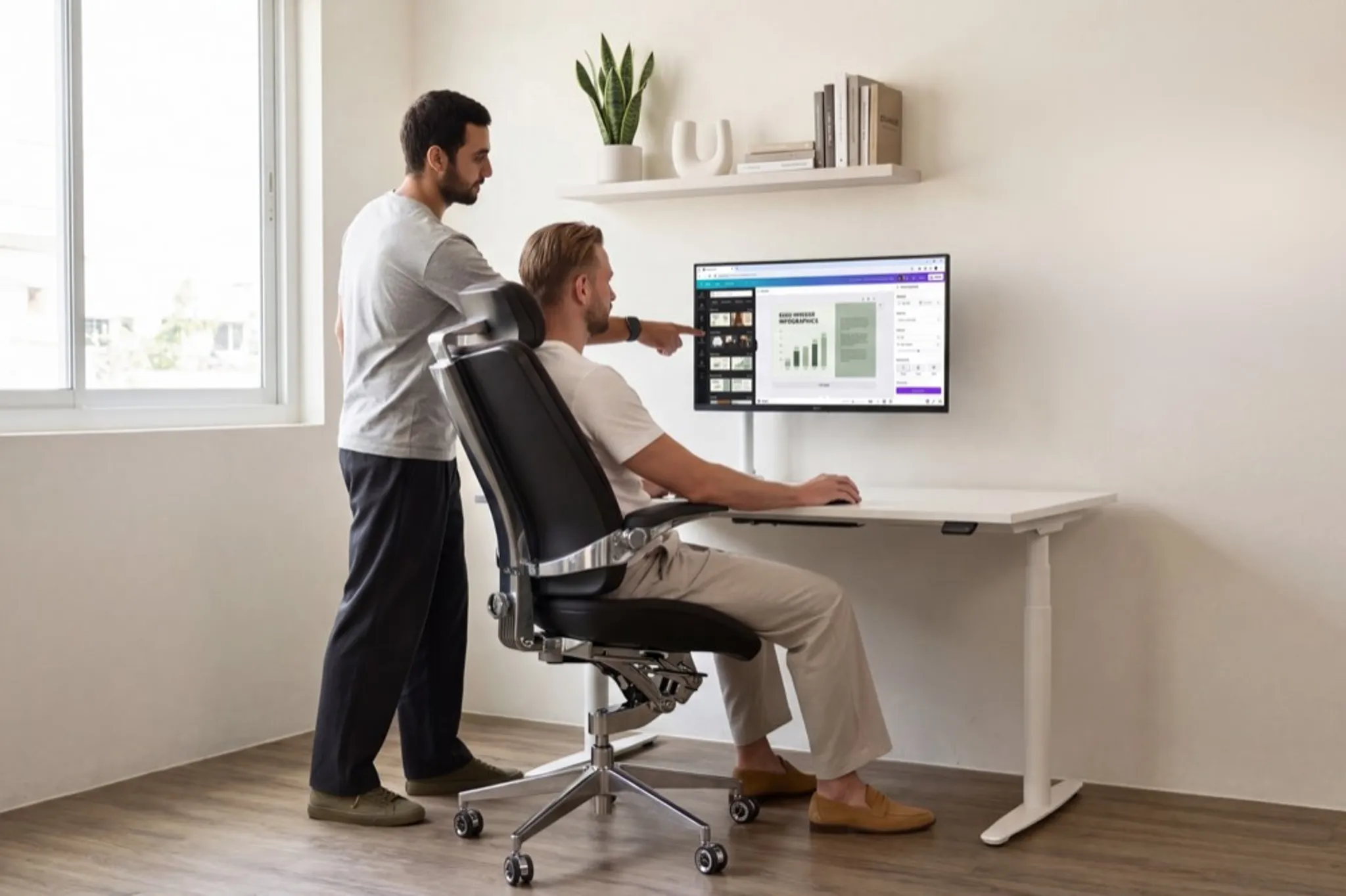
There is a familiar moment in desk work. You begin the day sitting well. Both feet down, screen at the right height, the chair that felt excellent in the showroom doing its job. Then the day starts to happen. You lean forward to read a difficult paragraph. You turn to answer a question. You recline during a call. A few hours later the chair has not changed, but the way you are using it has, and that is usually when comfort becomes something you have to manage.
We have become very good at telling people to sit correctly. We are less good at designing chairs that admit people do not work in a single position.
Stillness is not the goal
The language of office seating treats stillness as a success. A chair "holds" you. A backrest "keeps" you in place. Adjustments "lock" a posture. Those functions are not bad in themselves; focused work needs stability. But stability and stillness are not the same thing, and the difference is not only about comfort. Static loading has a measurable cost. Nachemson's in-vivo disc-pressure measurements (Spine, 1981) found that unsupported sitting raised pressure on the lumbar discs by around 40 percent compared with standing. The body makes small changes of position through the day for a reason, and a chair that treats those changes as noise is working against the person in it.
The idea of a correct posture is appealing because it offers a clean answer. Set the chair. Place the screen. Sit upright. Hold still. But a day contains reading, typing, a video call, a quick conversation, a detailed edit, a moment of thought away from the keyboard, and a return to the same document. Each task changes where attention goes and how a person meets the desk. The better question is rarely "what is the perfect posture?" It is "what happens when I stop holding it?"
Why movement exposes weak design
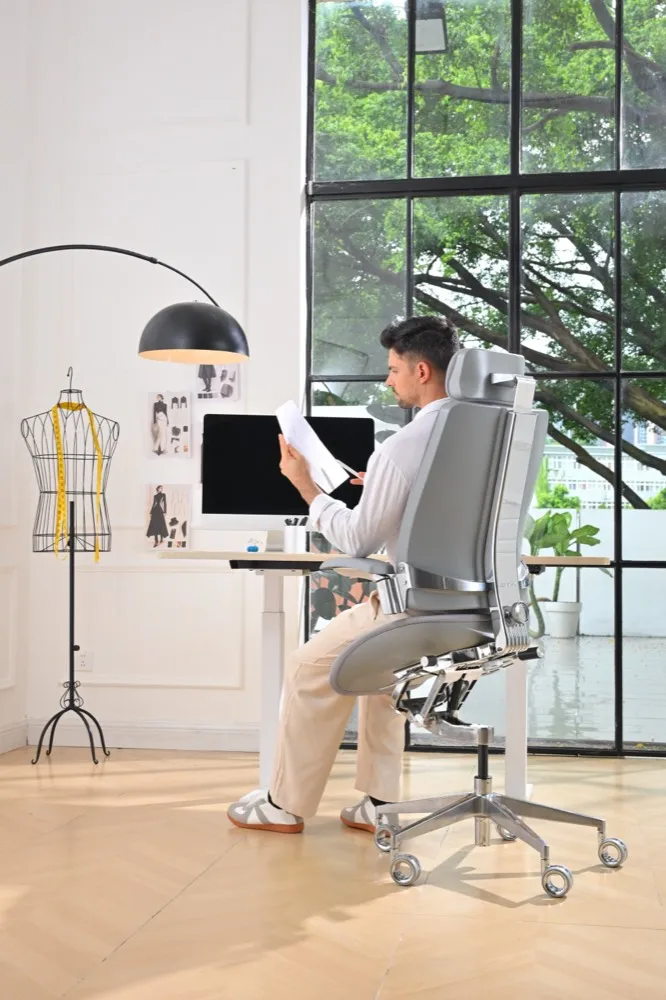
Most seating concepts have a moment where they work beautifully. A kneeling chair can open the hip angle. A saddle stool makes it easy to perch high. A well-built task chair is excellent when you are sitting straight and square to the desk. A recliner offers real relief. The limitation shows up in the transition. Lean forward on a traditional task chair and the backrest stops contributing. Stay on a stool long enough and the legs take over. Recline deeply and keyboard work turns awkward. The concept did not fail; it reached the edge of the job it was designed to do. That is the overlooked brief: a work chair has to be useful across positions, not merely excellent in one photograph. A fuller tour of those trade-offs lives in the alternative seating guide.
Look for friction, not failure
Good workstation advice becomes unhelpful when it turns a starting position into a command. A sensible setup gives you a place to begin, then makes small changes possible without drama. So rather than asking whether your posture is correct, look for the points where the setup becomes annoying.
- Do you move to the edge of the seat to reach the desk?
- Do you ignore a control because using it interrupts the task?
- Do you turn toward a second screen rather than repositioning it?
- Do you brace or reset the room in order to work differently?
Those are design clues, not personal failings. They mark where the workday is asking more of the body than the furniture is offering in return. The more a person has to brace, reach, or rearrange things to change position, the more likely they are to stay in the first position available. The workstation as a whole is where several of these clues resolve.
What happens between the adjustments
It would be easy to turn this into an argument against controls, and that would be wrong. Every work chair has them, and it should. The Vision Chair has a lever for the seat angle and another for height, the same as most chairs on the market. Controls are how a chair fits a particular body at a particular desk, and no geometry replaces that.
The question is a narrower one: what happens in the hours between adjustments?
On most chairs, the setting you dial in is only correct for the posture you were in when you dialled it. Lean forward from there and the backrest stops reaching you, the hip angle shuts, and the support you set up quietly stops applying. Nothing has broken. You have simply left the position the setting was for, and getting it back means reaching for the lever again.
That is the thing worth designing out, and it is where Levitask's approach differs. The seat angles up to 18 degrees forward of flat, the patent-pending T-Mech™ moves it along a knee-pivoted arc, and the backrest is linked to it, so the hip angle stays open across the whole range rather than only at the point you set. Change position and you are still supported at the setting you already chose. You are not re-tuning the chair every time the task changes.
Set it well once, in other words, and it keeps holding while you work. The one thing it does ask of the room is a desk that can change height, since the seat angle raises how high you sit.
The value is not that the chair becomes medicine. It is that it removes moments where you have to choose between leaning into your work and staying supported by the chair. This is the point of view behind the category Levitask calls Elevated Seating. It is a modest ambition, and an important one: a good workday contains more than one position, and the furniture should make that feel ordinary.
The measure of a good chair
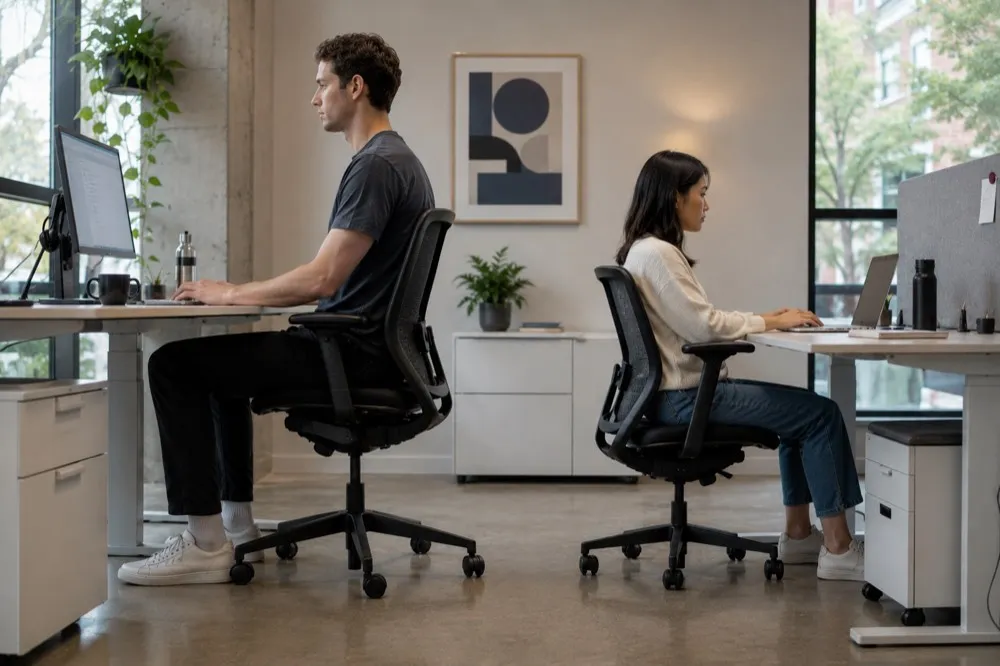
Do not judge a chair by its first five minutes. Judge it by the transitions that make up a real day.
- Can you lean forward without feeling pushed off the seat?
- Can you recline without losing contact where you need it?
- Can you change position without reaching for a lever every time?
- Does it support the way you actually work, not the way you imagine you will?
Those are not minor details. They are the difference between furniture that asks for compliance and furniture that stays with you. The chair should not win by making you still.