
Buying Guide
Are Kneeling Chairs Good for Your Back? What They Fix and What They Cost
Kneeling chairs open the hip angle and ease slouching, but load your shins and give no back support. Who they suit and what carries a full workday instead.
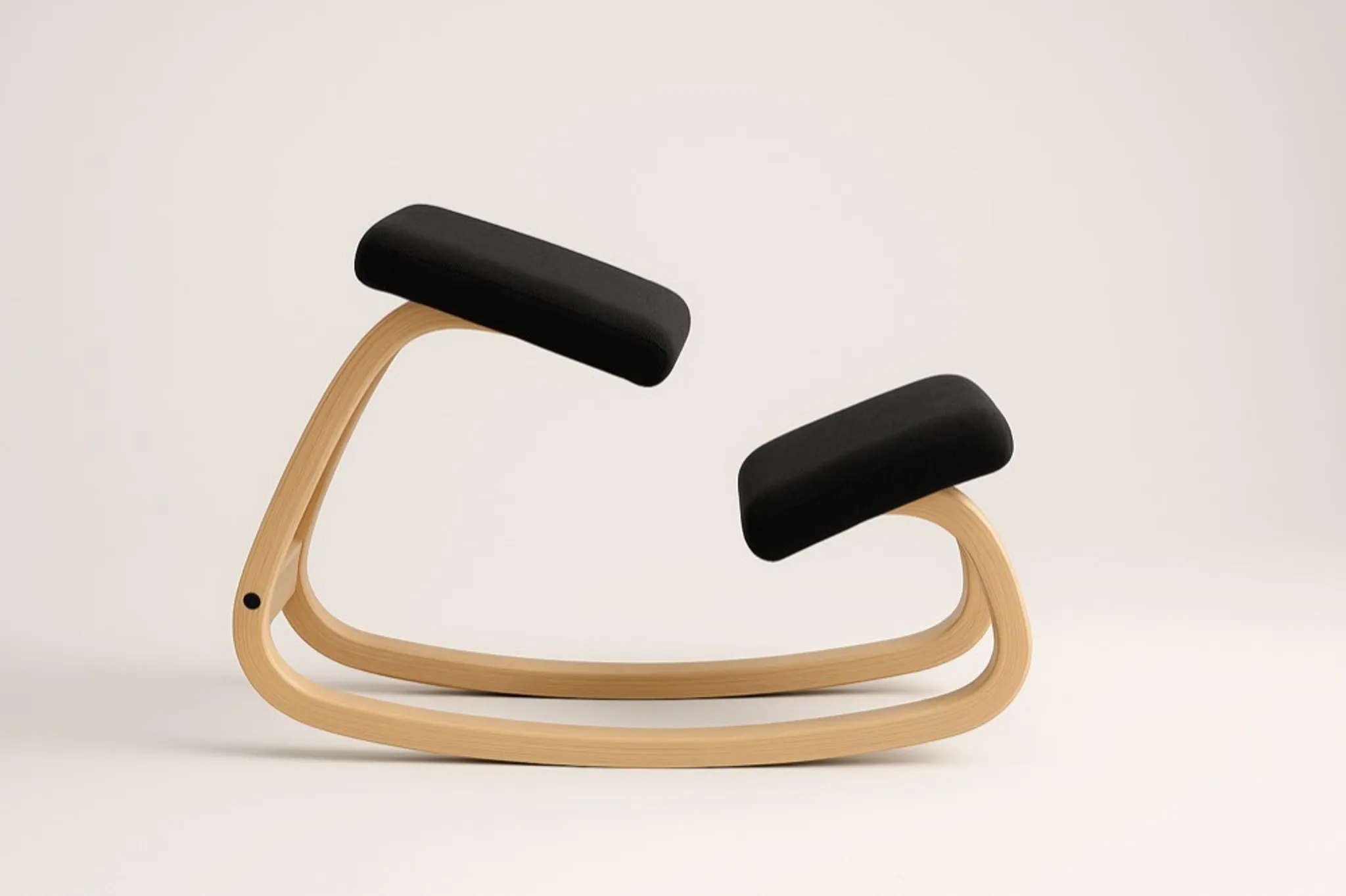
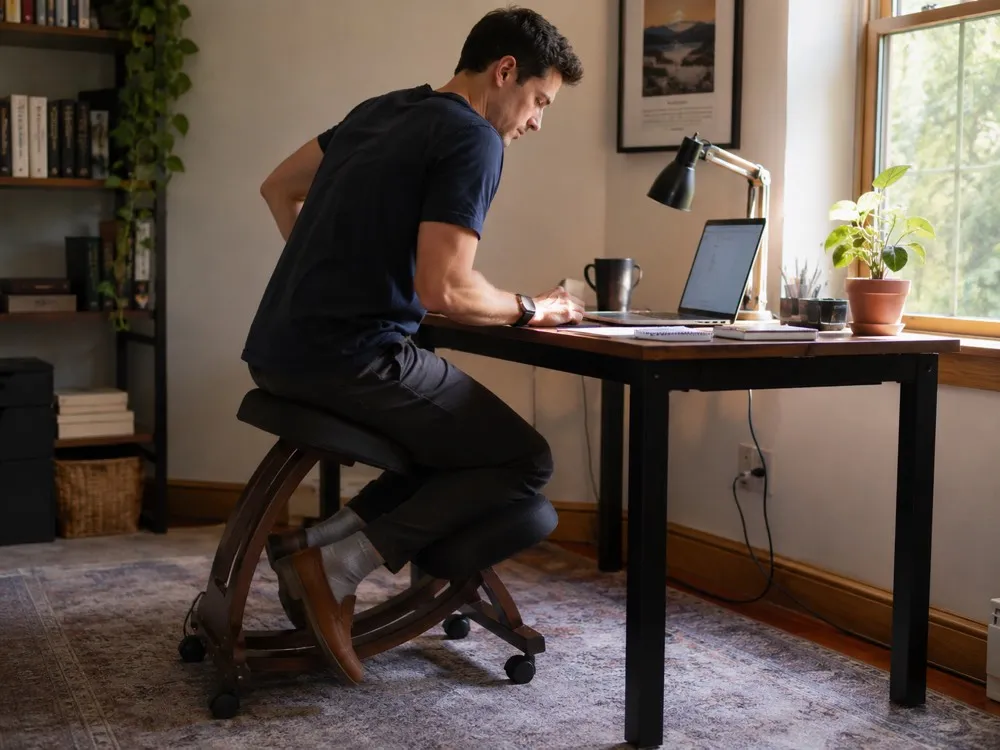
A kneeling chair asks your shins to take on a job your sit bones normally do alone. That trade is the whole product: the seat tilts 20 to 30 degrees forward, a pad catches your lower legs, and your pelvis rolls forward so your spine stacks into its natural curve. For anyone whose lower back aches after long desk days, the pitch is hard to resist.
Part of it holds up. The forward tilt does something real for your lower back, but it works in a narrow window, and it collects rent from your knees. What follows: the mechanism, who the design actually serves, what changes between day one and week four, and what to look at when a kneeling chair stops being enough.
How does a kneeling chair actually work?
The design is simple. A seat pitched steeply forward, a shin pad below it, and your weight split between seat and lower legs instead of resting fully on your sit bones.
That forward tilt is the whole idea. A flat office seat holds your thighs at roughly 90 degrees to your torso, and at that angle the pelvis tends to roll backward while the lower back flattens into a slouch. Keegan's radiographic studies (The Journal of Bone and Joint Surgery, 1953) placed the angle between trunk and thigh that best protects the lumbar curve near 135 degrees; at 90 degrees the pelvis rotates back and the curve flattens. Bridger later tested forward-sloping seats directly (South African Journal of Physiotherapy, 1985) and found seats tilted 10 to 15 degrees forward preserved the lumbar curve where flat seats did not.
So the mechanism is genuine. A kneeling chair nudges your pelvis and lower back toward a healthier shape without you having to think about it. For someone who slumps the moment they stop concentrating, that passive correction is worth something.
So are kneeling chairs good for your back?
For short, focused sessions, yes, many people feel real relief. The forward posture takes pressure off a tired lower back and can break the habit of slumping. If your pain comes mostly from collapsing into a C-shape by mid-afternoon, the kneeling position interrupts that pattern.
The catch is what the kneeling chair does not do. It has no backrest, so it supports your back only in the sense that it stops you slouching, not in the sense of holding you up. Your own muscles do all the work of staying upright. That is fine for twenty minutes and tiring across a full workday. When those muscles fatigue, you start to slump forward or shift your weight in ways that undo the benefit.
There is also the pressure question. Your shins and knees now carry a share of your body weight they were never built to hold for hours. Some people acclimate. Others find their shins ache, their feet tingle, or their knees complain long before the workday ends.
Getting in and out is its own small friction. A kneeling chair is not something you swivel away from to grab a coffee. You climb into it and climb out, which quietly discourages the movement a healthy back actually wants.
Who gets the most out of a kneeling chair?
Kneeling chairs are not a gimmick, and it helps to be specific about who they serve well:
- People who work in short bursts. If you sit for focused thirty-to-sixty-minute stretches and then get up, a kneeling chair fits that rhythm nicely.
- Chronic slouchers who want a physical reminder. The geometry makes slumping harder, which can retrain a habit over time.
- Anyone using it as one station among several. Paired with a standing desk or a normal chair you rotate through, a kneeling chair is a good posture break rather than a permanent seat.
- Younger, lighter, or more mobile users who tolerate shin loading comfortably.
If that is you, a kneeling chair is a reasonable, low-cost thing to try.
What changes between day one and week four?
The first day and the fourth week are two different reviews. Early on, the novelty and the fresh posture feel good. You sit taller, your lower back thanks you, and you assume the problem is solved. Then daily reality sets in, and around the two-to-four-week mark three things tend to surface.
Muscle fatigue arrives first. Holding yourself upright with no back support is tiring over eight hours, and tired muscles slump. Plenty of long-term users admit they end up perched forward and rounded by late afternoon, which is the exact posture they bought the chair to avoid.
Contact pressure comes next. Shin and knee discomfort that was unnoticeable in week one becomes the thing you think about at 3 p.m. Circulation and pressure points do not always agree with the design.
Movement hunger is the third. Your body does not want one fixed posture, even a good one. It wants to shift, recline, lean, and change position through the day. A kneeling chair locks you into a single forward pose, and a single pose held too long is its own kind of strain, however correct it looks on paper.
The pattern repeats across posture seating in general: a device fixes one position, then fails the moment you need to shift out of it. Saddle stools, ball chairs, and forward-tilt seats all hit a version of the same wall. You can see the full landscape in our complete guide to alternative and posture seating.
Kneeling chair vs the alternatives
A kneeling chair is one answer to the forward-posture question, and it is worth seeing it next to the others. A saddle stool tips your pelvis forward through the seat shape instead of your shins, which removes the knee loading but usually leaves you without meaningful back support; backed saddle models exist, but the backrest tends to be small and low. We break that specific matchup down in kneeling chair vs saddle stool, and cover the saddle concept on its own in are saddle chairs good for your back. If you have already decided a kneeling chair is not going to carry a full workday, the more useful read is the best kneeling chair alternative for all-day desk work.
What a kneeling chair gets right, and where it falls short
What it gets right: opening the hip angle to restore the lower-back curve is sound ergonomics, and doing it passively, so you do not have to concentrate on your posture, is a real benefit. For short sessions and as a posture break, a kneeling chair earns its place.
The costs: no back support, so your muscles fatigue and you eventually slump anyway. Shin and knee pressure that builds over hours. Restricted movement in and out. One fixed posture when your body wants many. It is a short-session tool asked to do a full-day job, and it strains under that ask.
The open angle, without the shin pads
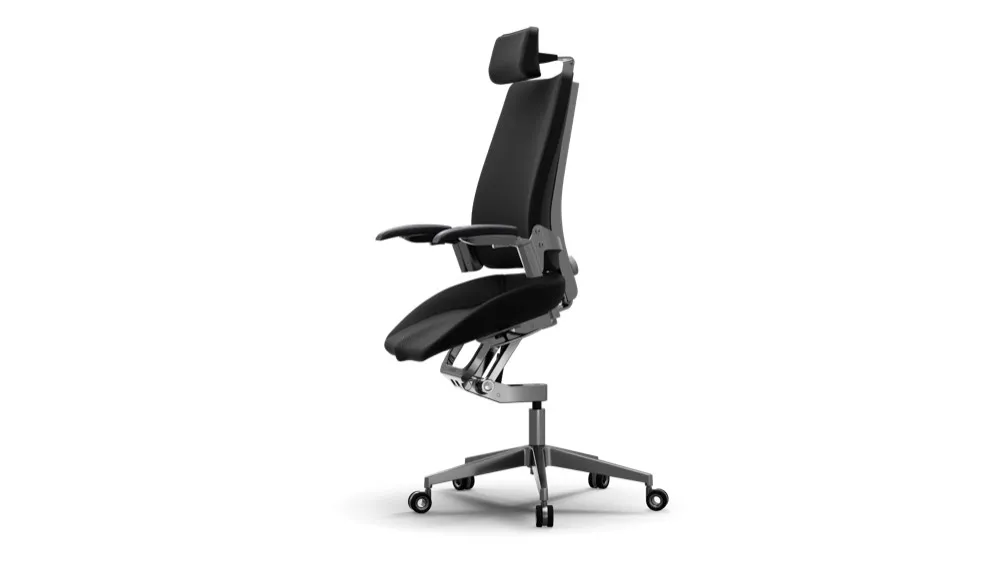
Stand up and your hips open to roughly 115 to 125 degrees while your lower back holds its curve with no effort. A kneeling chair reaches for that angle by dropping your shins onto a pad. The Vision Chair reaches for it by angling the seat instead, up to 18 degrees forward of flat, which tips the pelvis forward and lets the lumbar curve return on its own. Nothing has to press into your back, and nothing rests on your shins.
The backrest is linked to the seat and travels with it, which is why the angle holds rather than needing to be held. Lean in to work and the chair does not shut you up; and because a sloped seat makes a poor position feel wrong within seconds, you notice long before your back does. That, plus the patent-pending T-Mech™ swinging the seat on a knee-pivoted arc so your thighs stay supported, is the category Levitask calls Elevated Seating. The trade-off is that angling the seat also raises how high you sit, so it wants a desk that can rise to match.
A kneeling chair is a fair tool for short bursts. If you want the open angle to last a full working day, that is the job the Vision Chair was built for; it earned the Best of NeoCon 2026 Innovation Award. You can see how it works at the Vision Chair.
The trade-off is at the desk rather than the body. Because the seat tilts forward you sit higher, so a height-adjustable desk is part of the arrangement. A kneeling chair asks your shins to pay for the open angle; this asks your desk to rise instead.
Frequently asked questions
Can a kneeling chair fix bad posture permanently?
It can help retrain a slouching habit by making the upright position the default, but it does not permanently fix posture on its own. Posture improves from a mix of movement, strength, and varied positions through the day, not from one seat holding you in place.
Are kneeling chairs bad for your knees?
They can be for some people. A kneeling chair shifts part of your body weight onto your shins and knees, and over long sessions that pressure can cause aching or numbness. Padding and your own build make a big difference, so comfort varies from person to person.
How long can you sit in a kneeling chair each day?
Most people do best using a kneeling chair for short-to-medium stretches, roughly thirty minutes to a couple of hours at a time, then changing position. Using it as your only seat for a full eight-hour day is where the muscle fatigue and shin pressure usually show up.
Is a kneeling chair better than a normal ergonomic chair?
Neither is simply better; they solve different problems. A kneeling chair promotes a forward, open-hip posture but has no back support. A good ergonomic chair supports one seated posture comfortably for hours. The gap both leave open is supported movement between postures, which is what Elevated Seating is built around.