
Elevated Seating
What We Mean When We Say 'The Angle Never Closes'
The angle never closes describes the hip angle between torso and thighs holding open, roughly 115 to 125 degrees, through a chair's full range of movement. Here is the geometry behind the phrase and what it does not claim.
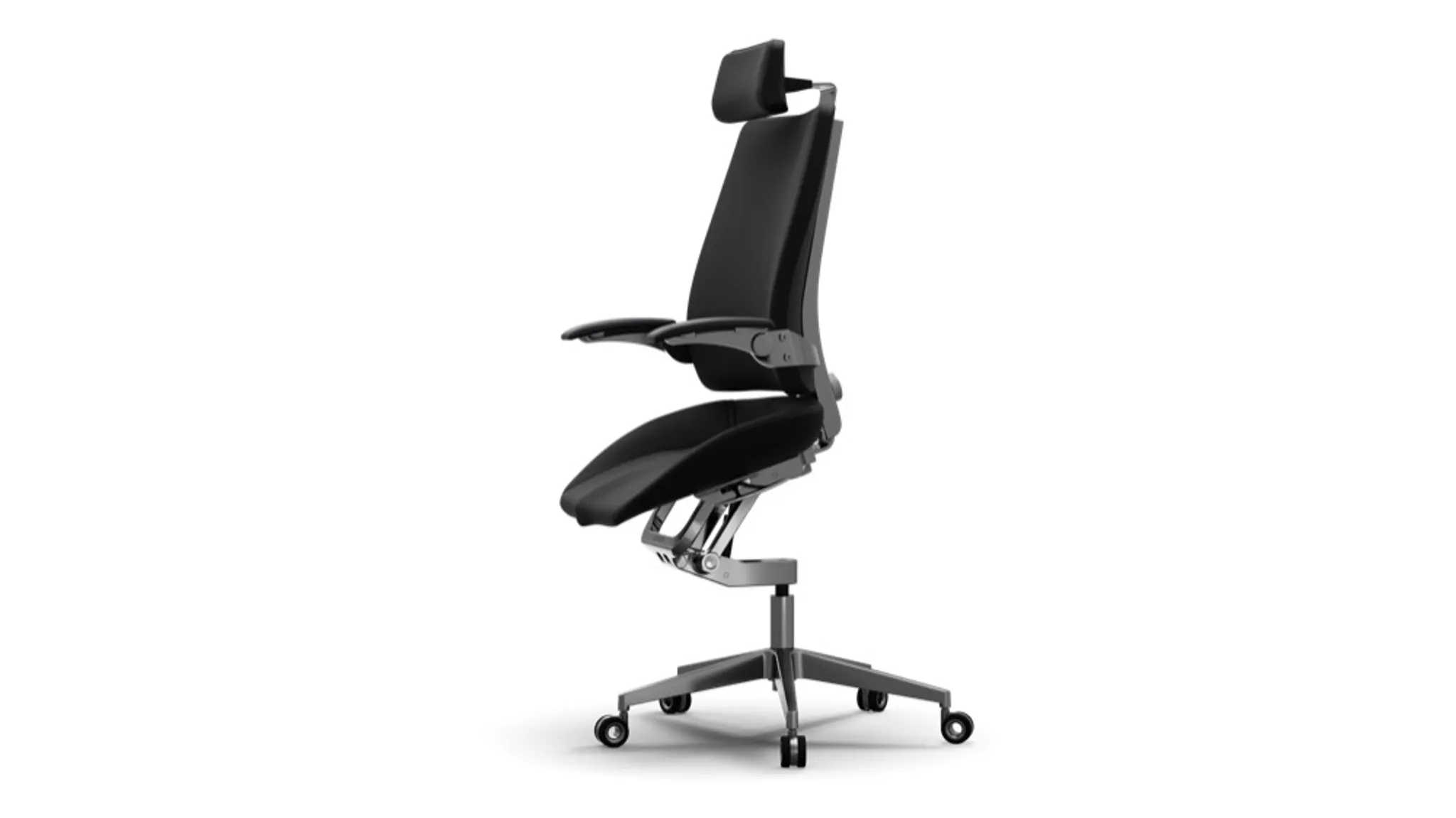
It is a short phrase, and it earns a precise explanation.
The angle in question is the one between your torso and your thighs, the hip angle. In a conventional working chair, that angle tightens as you move toward the desk. In the Vision Chair, the seat and backrest are designed to hold an open hip angle of roughly 115 to 125 degrees across the chair's range of movement, from a reclined position to a forward working one.
It is worth being exact about what that claims, because the phrase is easy to over-read. It describes the chair, not your spine. Nothing stops you sitting bolt upright, perching on the front edge, or leaning away from the backrest entirely. This is a chair, not a brace. What the phrase means is narrower and more useful: across the chair's own movement, the seat and backrest keep their open relationship, so the angle is not a setting you have to find and then defend. Leave the chair to it and the open posture is where you end up.
Why 115 to 125 degrees, and not 90
The 90-degree seated pose is a convention of furniture, and the seating literature has questioned it for decades. Keegan's radiographic study of the lumbar curve (The Journal of Bone and Joint Surgery, 1953) found that the trunk-thigh angle that best preserved the natural curve of the lower spine sat closer to 135 degrees, and that at 90 degrees the pelvis rotates backward and the curve flattens. An open hip angle keeps the pelvis upright, which is the posture a standing body already has. The Vision Chair aims for a working figure a little tighter than Keegan's ideal, enough to keep you close to the desk while staying meaningfully more open than 90 degrees.
Why the angle usually changes
Most chairs give you an open angle somewhere. Reclining opens space between torso and thighs. A forward-tilting stool opens it while you perch. The trouble is movement. Lean forward in many task chairs and the pelvis rolls into a more closed position. Tilt a plain seat forward and the body starts to slide toward the front edge, so you brace, reset, or change how you sit. This is not the failure of any one chair. It is a familiar trade-off about how the seat and the body travel together.
The role of the T-Mech
The patent-pending T-Mech™ is Levitask's answer to that trade-off. The seat travels on an arc with its pivot at the knee. As you recline or lean in, the movement is meant to keep the thighs supported by the seat rather than letting the body drift away from it. So the open angle is not a setting you find and then defend. It is carried along by the way the seat moves, which is why the same idea shows up when you look at the seat as a moving surface.
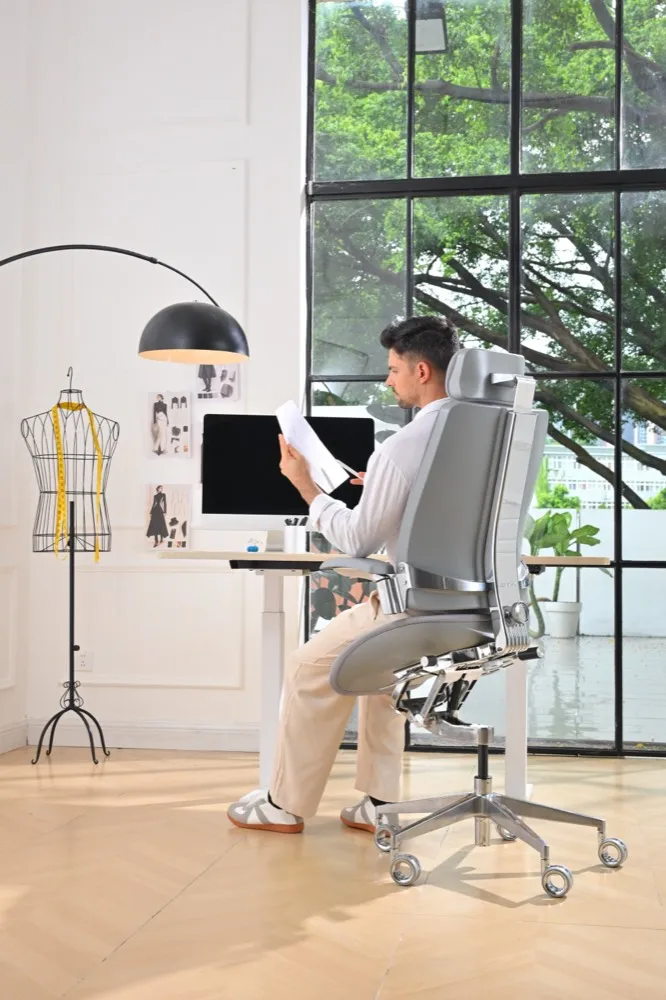
There is a second consequence people notice before they notice the angle. Opening the seat also lifts you, so you sit higher than a flat seat would put you. That is why Elevated Seating is designed around a height-adjustable desk: the work surface rises with the angle rather than staying where a conventional chair left it.
The slope tells you when you are wrong
There is a quieter effect that matters more day to day than the geometry does.
On a flat seat you can sit badly for hours without noticing. The chair is equally happy holding you in a slump, so the only thing keeping your posture in shape is you remembering to check it, which nobody does past about eleven in the morning.
A sloped seat does not let you get away with it. Perch too far forward and you start to slide, which you feel immediately. Let your pelvis roll back into a slouch and the position simply feels wrong, because the seat is no longer under you the way it was a moment ago. You are not being corrected by a rule you are supposed to remember. You are getting physical feedback, in seconds rather than hours.
The flip side is the part that makes it workable: the good position is also the comfortable one. Sitting with your hips open on an angled seat is not a discipline you maintain, it is the path of least resistance. That is the real argument for the geometry, and it is a more modest claim than saying the chair cannot put you at 90 degrees. It can. You just will not want to stay there.
What it feels like across a day
You lean forward to edit a document. You sit tall for a call. You recline to think. A chair that supports only one of those moments can still be a good chair, but you end up working around the point where its support changes. The Vision Chair is built to make those transitions feel less separate, so the open angle stays part of the movement rather than vanishing the moment the task changes.
What the phrase does not mean
It does not mean every person will feel the same thing. Desk height, proportions, task, and setup all matter. It does not mean the chair treats pain, or replaces movement, breaks, strength, or a well-considered workstation. It means Levitask designed the Vision Chair around the changing positions of a real workday, and "the angle never closes" is the shortest way to name the mechanical idea underneath it. For the wider category this belongs to, see what Elevated Seating means.
Frequently asked questions
What does "the angle never closes" mean?
It describes the chair rather than the sitter. Across the Vision Chair's range of movement the seat and backrest hold an open hip angle of roughly 115 to 125 degrees, instead of tightening as you lean toward the desk. You can still choose to sit upright or perch forward; the phrase means the chair is not the thing closing you up.
Is a 90-degree sitting angle bad?
It is a furniture convention rather than an anatomical rule. Keegan's 1953 research found a more open trunk-thigh angle better preserves the natural lumbar curve. A chair is not a treatment, and no single angle is right for every body or task.
How does the Vision Chair keep the angle open?
Its patent-pending T-Mech moves the seat along an arc that pivots at the knee, keeping the thighs supported so the pelvis stays upright as you recline or lean forward.