
Guide
Sciatica From Sitting: What May Contribute and Desk Adjustments to Consider
Leg pain that builds at your desk and eases when you walk? Learn why sitting aggravates sciatica, six desk fixes that help, and when to see a doctor.
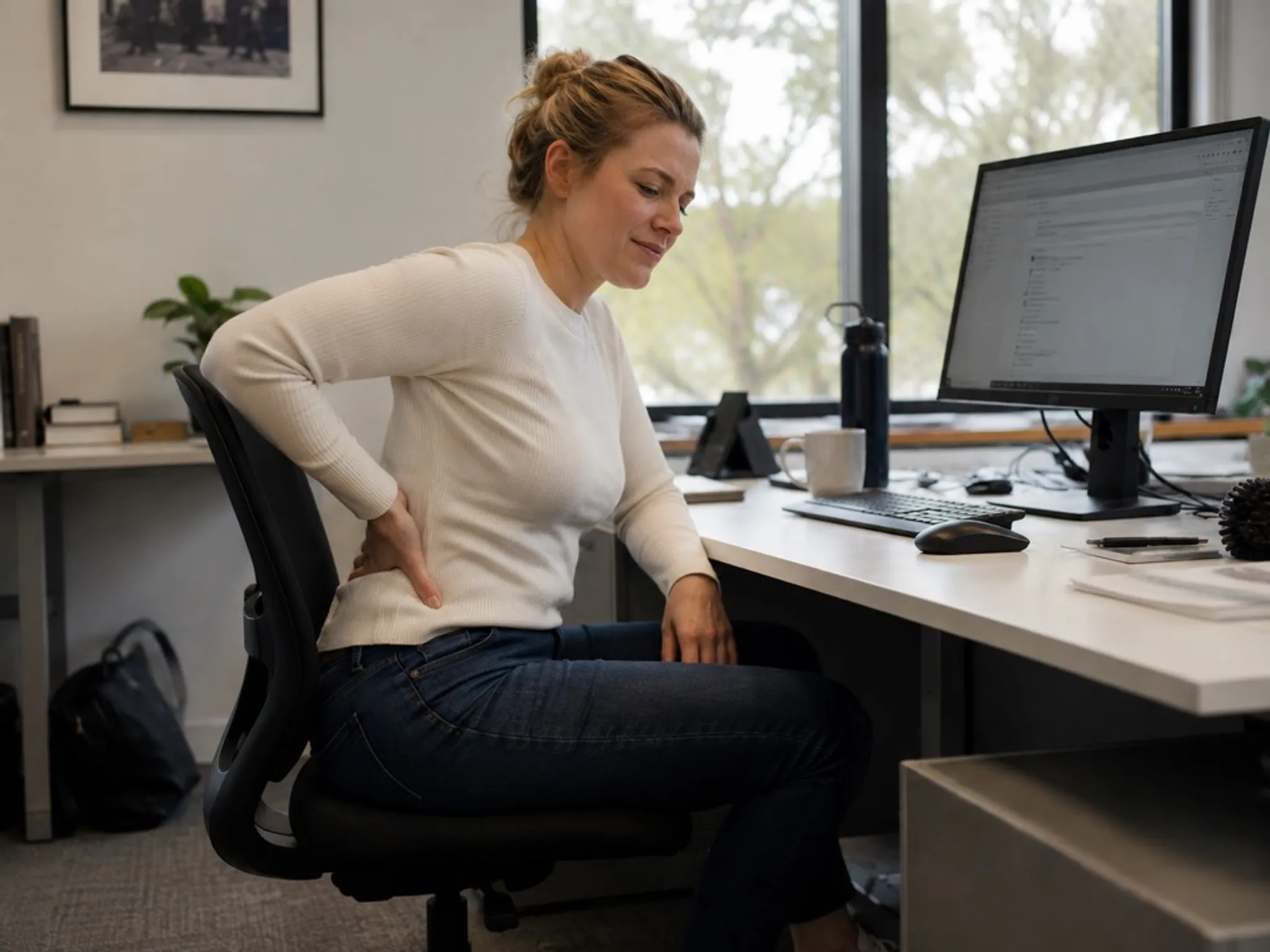
If your leg starts to ache, tingle, or go numb somewhere around hour three at your desk, you are not imagining it. A lot of people first meet sciatica in an office chair. You sit down feeling fine, and by mid-afternoon there is a hot line running from your lower back through one buttock and down the back of your leg. Stand up, walk to the kitchen, and it eases. Sit back down, and it creeps back.
What is sciatica, really?
Sciatica is not a diagnosis on its own. It is a description of a symptom: pain, tingling, burning, or numbness that travels along the path of the sciatic nerve. That nerve is the largest in the body. It runs from the lower spine, through the buttock, and down the back of each leg. When something presses on or irritates it, you feel that pressure as a signal firing down the leg, often on one side only.
The "something" varies. It can be a bulging or herniated disc leaning on a nerve root, a narrowing of the space the nerve passes through, or the piriformis, a small muscle deep in the buttock that sits right on top of the nerve. These causes are genuinely different, and the right response depends on which one you have. A chair does not diagnose you, and neither does an article. What sitting does is turn up the volume on whatever is already going on.
Why does sitting make sciatica worse?
Sitting is a surprisingly demanding posture for the lower back. When you stand, the load on your lumbar spine is shared and moving. When you sit, especially slumped in a soft chair, that load concentrates. Nachemson's disc-pressure measurements (Spine, 1981) found that unsupported sitting loads the lumbar discs about 40 percent more than standing. Three things tend to stack up over a long day.
First, the hip angle closes. A standard chair holds you at roughly ninety degrees at the hip, which shortens and tightens the hip flexors and lets the pelvis roll backward. That backward roll flattens the natural inward curve of your lower back and increases pressure toward the front of the lumbar discs. Keegan's radiographic work (The Journal of Bone and Joint Surgery, 1953) gauged the trunk-thigh angle that protects the lumbar curve at roughly 135 degrees; at 90 degrees the pelvis rolls back and the curve goes flat. If a disc is already unhappy, this is the position it likes least.
Second, you sit on the nerve's neighborhood. Your body weight presses down through the sit bones, the buttock, and the piriformis, exactly where the sciatic nerve runs. A hard front seat edge or a flat, unsupportive cushion can add direct pressure on the back of the thigh, which is why the pain often worsens the longer you stay put.
Third, you stop moving. Nerves and discs rely on small, constant shifts to move fluid and blood around. Hold one position for hours and that circulation drops. Put the three together and you have the reason sitting aggravates sciatica more than almost any other daily habit: a closed hip, concentrated pressure, and stillness, held for eight hours at a stretch.
How can you tell sitting is the trigger?
A few patterns point toward sitting as the aggravator rather than the root cause. None replace an assessment, but they are worth noticing so you can describe them to a clinician.
- The pain builds the longer you sit and eases when you stand or walk.
- It is worse first thing after a long drive or a long meeting.
- It usually runs down one leg, not both, and can reach past the knee.
- Leaning forward at the desk, or slumping back into a soft couch, makes it sharper.
- A short walk resets it, at least for a while.
If that sounds like your day, the good news is that the daily driver is something you have real control over. The environment is doing the aggravating, and the environment can change.
Which desk changes make a difference?
You do not need to overhaul your life. Most people get meaningful relief from a handful of adjustments that reduce closed-hip pressure and reintroduce movement. Here is how the common changes map to what they are actually doing.
| Change | What it targets | Why it helps |
|---|---|---|
| Stand or walk every 30 to 45 minutes | Stillness | Restores circulation and unloads the nerve and discs before pressure builds |
| Raise your screen to eye level | Slump and forward lean | Keeps you from collapsing forward and rounding the lower back |
| Open your hip angle past 90 degrees | Closed hip, flattened lumbar curve | Lets the pelvis sit more upright so the lower back keeps its natural curve |
| Support the lower back in the upright working posture | Flattened lumbar curve | Holds the inward curve while you actually work, not just when you recline |
| Soften or clear the front seat edge | Direct thigh and nerve pressure | Reduces the hard-edge pressure that many sciatica sufferers feel most |
| Keep feet flat and thighs supported | Uneven seat pressure | Spreads load evenly instead of concentrating it under the sit bones |
The theme across every row is the same. Reduce the pressure on the nerve's path, keep the lower back in its natural curve, and keep moving. A closed, static, ninety-degree hip is the thing you are trying to get away from.
For the seating side of this specifically, the deeper guide on what to look for in an office chair for sciatica sets out the selection criteria in detail, and if you want gentle movements you can do without leaving your seat, see the page on chair stretches for sciatica.
Which movements do people find helpful?
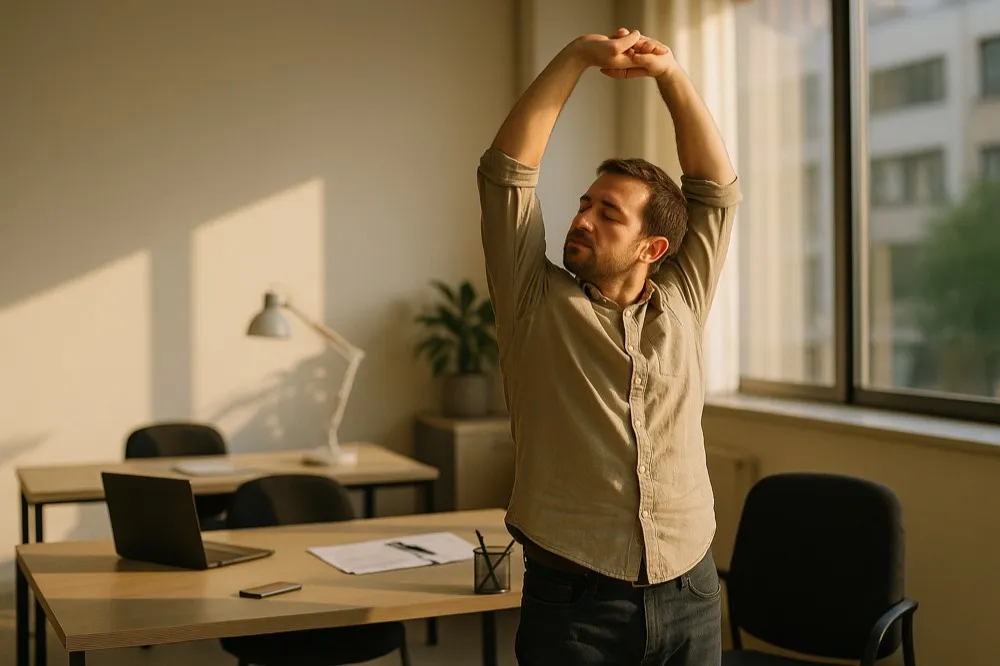
Movement is the most commonly recommended first step, and it costs nothing. The point is not to push into pain. It is to interrupt the stillness and gently mobilize the areas that stiffen with sitting.
Walking is the simplest. A few minutes every half hour does more than one long walk at the end of the day, because it breaks up the loading before it accumulates. Beyond that, gentle movements people are often taught include a seated figure-four to open the buttock, a slow spinal twist, and hip flexor and hamstring stretches to counter the shortening that sitting causes. These are described plainly and safely on the chair stretches for sciatica page.
Because so much sciatica from sitting traces back to a closed hip and a tight front of the hip, the work on tight hip flexors from sitting and on anterior pelvic tilt is closely related. Stretch and strengthen all you like, though, and you will still spend most of your waking hours in the position that caused the trouble. That is the catch no stretch routine escapes.
When should you see a professional?
This matters, so read it plainly. Sciatica can be mild and self-settling, or it can be a sign of something that needs proper care. See a qualified clinician, a doctor or physiotherapist, if any of the following apply:
- Severe pain, or pain that keeps getting worse rather than better.
- Numbness, weakness, or a loss of feeling in the leg or foot.
- Pain that wakes you at night or does not improve after a few weeks.
- Any change in bladder or bowel control, or numbness around the groin. This is urgent, seek care immediately.
No chair, stretch, or article on the internet substitutes for a proper assessment. The desk changes here are about comfort and reducing daily aggravation. They are not treatment, and they do not replace medical advice.
Does your chair matter for sciatica?
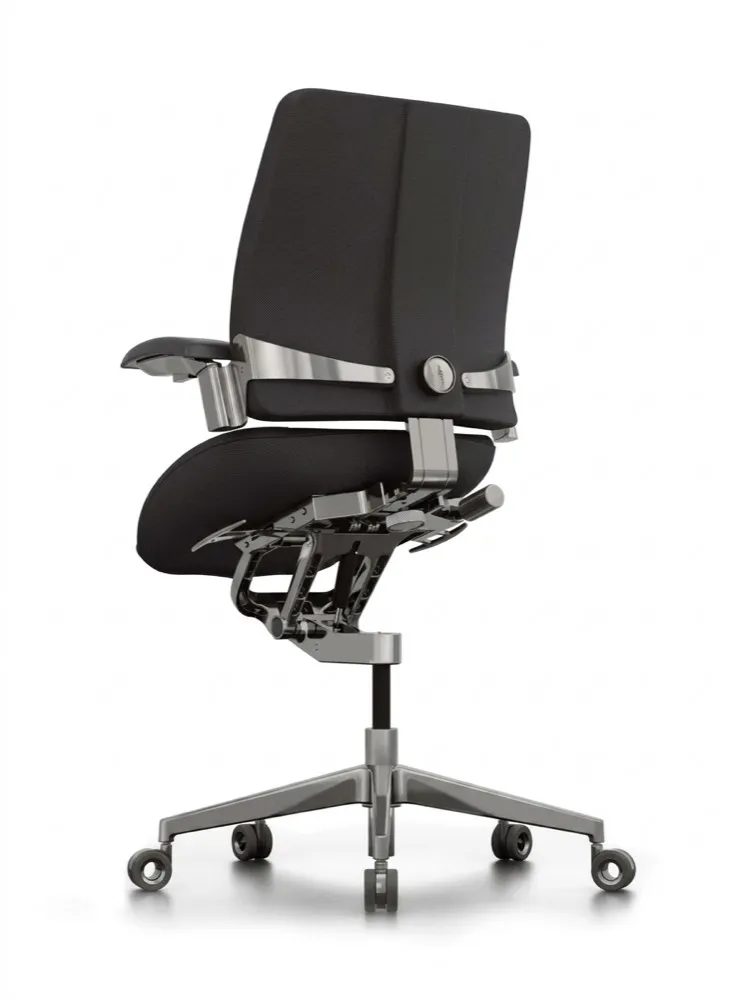
Every stretch above competes with the hours you spend closed at ninety degrees. Changing the chair ends that tug-of-war. The Vision Chair belongs to a category Levitask calls Elevated Seating, built around a seat that angles up to 18 degrees forward of flat. That tips the pelvis forward, and because the backrest is linked to the seat and travels with it, the hip angle stays open between roughly 115 and 125 degrees across the chair's range, so the position that aggravates the nerve stops being the one the chair encourages. Its patent-pending T-Mech™ swings the seat around a pivot at the knee, keeping thighs and pelvis supported, while a dual-density foam seat cradles the pelvis instead of pressing a hard edge under the thigh. A chair cannot treat sciatica. It can stop feeding it for eight hours a day. More on the approach at the Vision Chair, and whatever you sit in, movement and professional advice come first.
A practical note on setup. The forward seat angle raises how high you sit, so a height-adjustable desk is needed to keep the work surface at the right height. At a fixed desk you end up reaching down, which closes the angle again.
Frequently asked questions
Can sitting cause sciatica, or only make it worse?
Prolonged sitting is more often an aggravator than a root cause. The underlying issue is usually a disc, a narrowing, or a muscle pressing on the nerve. Sitting turns up the pressure through a closed hip, concentrated load, and stillness, which is why symptoms so often flare at a desk.
Is it better to sit or stand with sciatica?
Many people find standing and walking ease sciatica because they unload the lower back and get things moving again. Neither all-day sitting nor all-day standing is ideal, though. Alternating, with a break every half hour or so, tends to be the more comfortable pattern for most.
How should I sit to reduce sciatica pain at my desk?
Aim for an open hip angle a little past ninety degrees, feet flat, thighs fully supported, the lower back holding its natural inward curve, and the screen at eye level so you do not slump forward. Then get up and move regularly. No single position beats regular movement.
When is sciatica from sitting serious enough to see a doctor?
See a clinician for severe or worsening pain, numbness or weakness in the leg or foot, pain that lasts more than a few weeks or wakes you at night, and immediately for any change in bladder or bowel control. These need a proper assessment, not a desk fix.
This guide is general information, not medical advice. Sciatica has several possible causes, and the right response depends on yours. Please consult a qualified clinician about your own symptoms.
For the wider picture, this page sits alongside guides on lower back pain from sitting and the full alternative seating hub.