
Guide
How to Fix Your Posture When You Sit All Day: Five Levers Ranked by Return
How to fix posture when you sit all day: why the slump happens, five changes ranked by return, and why your hip angle beats willpower every time.

You sat down at 9am with good intentions. By 3pm your shoulders have crept toward your ears, your chin has drifted toward the screen, and your lower back has quietly given up. That slump is not a willpower failure. It is the predictable result of holding a moving animal in one closed position for six hours, and fixing it starts with removing what works against you, not gritting your teeth harder.
What follows is the desk worker's version of the answer: what good posture actually is, why a working day erodes it, and the five changes that return the most for the least effort.
What does good posture actually look like?
Good posture is not a rigid, chin-up, chest-out military stance. That position is exhausting and nobody holds it for long. A more useful way to think about it: your body should be stacked so that gravity passes cleanly through it, with your muscles doing as little extra work as possible.
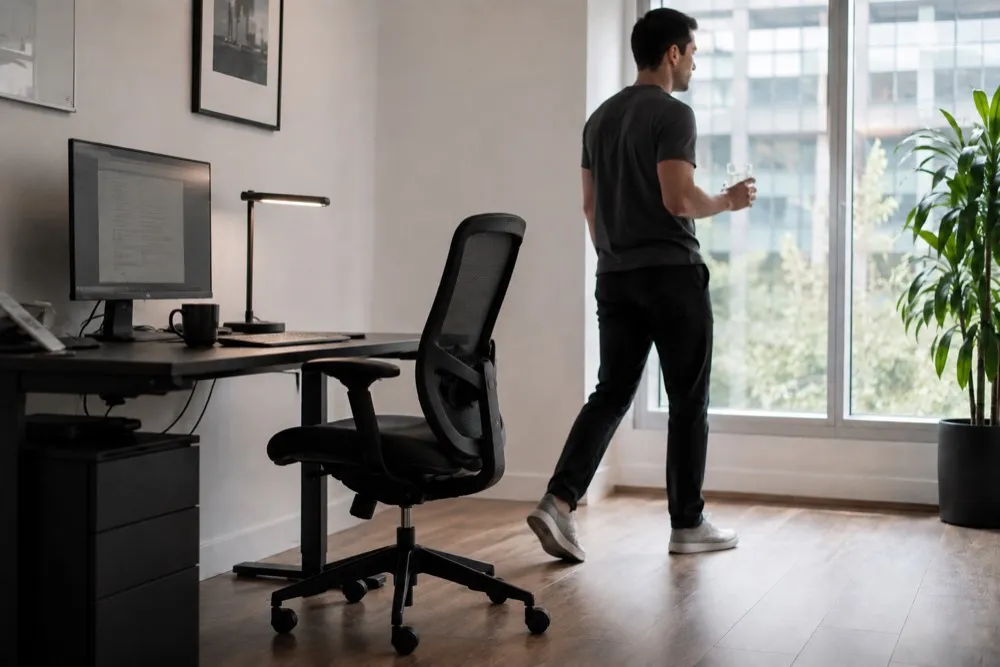
At a desk, that roughly means ears over shoulders, shoulders over hips, a gentle inward curve in the lower back, and a screen high enough that your head is not tipping forward to read it. Your feet rest flat, and your hips sit slightly higher than or level with your knees so the angle between your thighs and torso is open rather than crammed shut.
Here is the part most advice skips: the healthiest posture is not one position at all. It is many positions, cycled through often. Research on sitting generally suggests that the best posture is your next one. A body that shifts, leans, and resets all day handles load far better than one frozen in even a textbook-perfect stance.
Why does sitting all day wreck your posture?
Sitting is not evil, but sitting the way most desks force us to sit is a slow grind on the body. Three things happen.
First, a standard chair holds you at a sharp, roughly 90-degree hip angle and holds you there. Mandal argued in Applied Ergonomics (1981) that 90 degree sitting is an artifact of furniture design rather than anatomy, and that a working posture closer to half-standing, with a hip angle of roughly 120 to 135 degrees, is what the body is actually built for. Meanwhile your hip flexors, the muscles running from your thigh to your lower spine, sit shortened for hours. Over weeks and months they adapt to that shortened length and start pulling on your pelvis even when you stand. That is a direct driver of anterior pelvic tilt from sitting, where the pelvis rotates forward and the lower back over-arches.
Second, static loading. Muscles are built to contract and release. Hold any position long enough and the tissue fatigues, blood flow drops, and you start to slump because holding upright simply costs too much. The discs pay too: Nachemson's disc-pressure measurements (Spine, 1981) found unsupported sitting sends lumbar disc pressure about 40 percent higher than standing. This is where most lower back pain from sitting begins.
Third, the screen problem. Laptops and low monitors pull your head down and forward. Since the human head is heavy, every centimeter it travels forward multiplies the strain on your neck and upper back, which is the mechanism behind forward head posture, sometimes called tech neck.
None of these are moral failings. They are what happens when you put a moving animal in one fixed, closed position for the length of a working day.
Can you actually fix your posture, or just manage it?
It is more management than a one-time repair, and that is good news, because management is something you can win at.
Posture is not a fixed trait like eye color. It is the running average of the positions your body spends time in and the muscles that have adapted to them. Shorten the hip flexors and weaken the glutes and core, and your default posture drifts. Reverse those inputs and it drifts back. Many people find that consistent small changes make a visible, felt difference within a few weeks. What you cannot do is fix it once and forget it, because the moment you return to eight closed-hip hours, the drift resumes.
So the real question is not "how do I stand up straight right now." It is "how do I change my daily inputs so upright is my body's low-effort default."
Which changes actually move the needle?
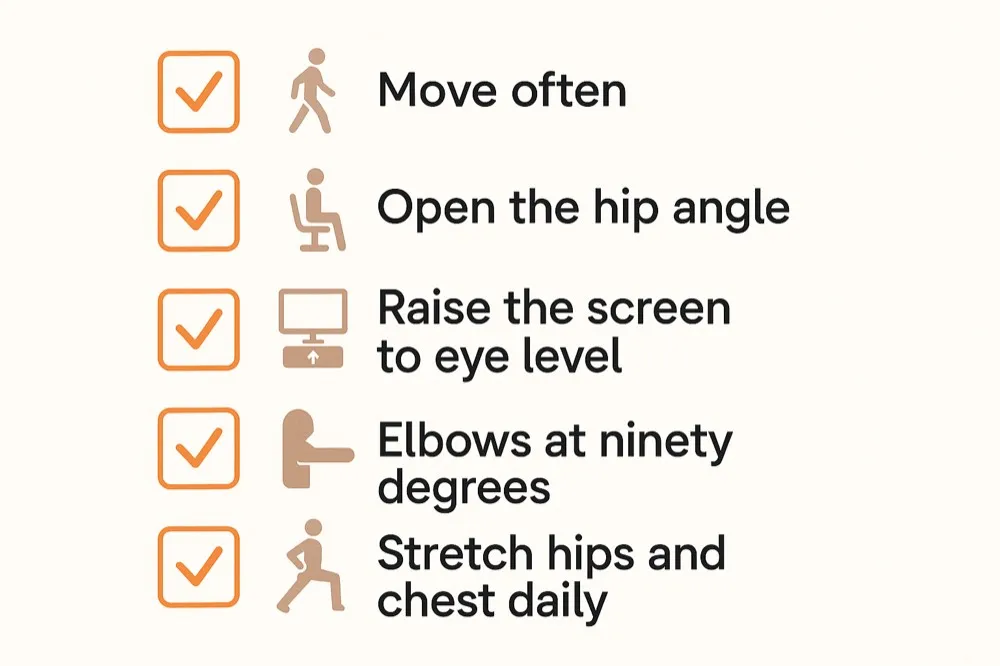
Most posture advice throws twenty tips at you. In practice a handful do the heavy lifting. Here is where to spend your effort, ranked by return.
| Change | Why it helps | Effort |
|---|---|---|
| Move and change position often | Breaks up static loading before slump sets in; the single most protective habit | Low, but needs a reminder |
| Open your hip angle past 90 degrees | Takes tension off shortened hip flexors and lets the pelvis sit neutrally | Low, depends on your seat |
| Raise your screen to eye level | Stops the head from tipping forward; directly reduces neck and upper-back load | One-time setup |
| Stretch hip flexors and chest daily | Undoes the shortening that pulls posture out of line | 5 to 10 minutes |
| Strengthen glutes and core | Gives the pelvis and spine the support to hold neutral without effort | A few short sessions a week |
Notice what is not at the top of that list: buying a lumbar cushion or reminding yourself to "sit up straight." Willpower reminders fade within minutes because the underlying inputs have not changed. The levers that last are the ones that change your environment and your tissue, not your moment-to-moment discipline.
If you want to go deeper on any one of these, the movement side is covered in our guides to tight hip flexors from sitting and the practical desk routines in anterior pelvic tilt exercises.
How do you fix specific posture problems?
Posture is not one thing, so the fixes branch by symptom. Use this as a map to the detailed guides.
- Lower back over-arched, belly pushed forward, stiff after sitting: this points to anterior pelvic tilt from sitting.
- Tightness and pinching at the front of the hips, trouble standing tall after a long session: start with hip flexor stretches for desk workers.
- Head and chin drifting toward the screen, aching neck and shoulders: see how to fix forward head posture.
- Aching, fatigued lower back that eases when you stand: read lower back pain from sitting.
- Pain that travels from the lower back down through the buttock or leg: that pattern belongs to sciatica from sitting, and it deserves careful, professional-guided handling.
You may recognize more than one of these in yourself. They often travel together because they share a root cause: a body held closed and still for too long.
How long does it take to fix your posture?
There is no fixed timeline, and anyone who gives you an exact number is guessing. What tends to be true is that comfort improves first and appearance follows. Many people notice less end-of-day stiffness within the first week or two of moving more and opening the hip angle. Changes you can see in the mirror, the kind driven by muscle length and strength adapting, generally take longer and depend on consistency.
The trap is expecting a straight line. Some days feel great, some days the old slump returns, especially under stress or a heavy deadline. That is normal. You are shifting an average, not flipping a switch.
When should you see a professional?
This guide is about everyday posture, not medical care. Posture habits are worth improving on your own, but pain is a different signal. See a qualified clinician, a doctor, physiotherapist, or chiropractor, if you have severe or persistent pain, pain that travels down your leg, numbness, tingling, or weakness, pain that wakes you at night, or discomfort that lasts more than a few weeks. Those symptoms can point to something a stretch routine will not address, and getting them assessed early is always the smarter move.
The tug-of-war your chair keeps winning
Every stretch and strength session above competes with the hours you spend held at 90 degrees. Changing the environment ends the tug-of-war. That is the idea behind Elevated Seating: the Vision Chair's seat angles up to 18 degrees forward of flat, tipping the pelvis forward so the lumbar curve returns on its own rather than being pushed back into shape by a pad, and the backrest is linked to that seat so the open 115 to 125 degree hip angle holds across the chair's range. The position that trains the slump in stops being the one the chair holds you in. That is the part that matters for posture specifically: on a flat seat you can slump for hours without noticing, while on a sloped one a rolled-back pelvis feels wrong within seconds and you correct it without thinking about it. Its patent-pending T-Mech™ keeps your thighs supported and your pelvis upright whether you recline or lean into your work. No chair treats or cures anything, and this one does not claim to. What it can do is make upright your low-effort default instead of a fight you lose by mid-afternoon.
Start with the habits. When you are ready for a seat that stops working against them, that is where the Vision Chair earns its place.
One caveat on the furniture. An angled seat opens the hip angle by raising how high you sit, so it needs a desk that can rise with it. If the desk is fixed at around 73cm, you will end up reaching down and losing the posture the angle gave you.
Explore more in our guide to active sitting or the wider alternative seating complete guide.
Frequently asked questions
Can you fix years of bad posture?
Often yes, to a meaningful degree. Muscles and soft tissue adapt to the positions you spend time in, and they can adapt back with consistent movement, stretching, and strengthening. Long-standing structural issues are harder and worth checking with a professional, but everyday desk-driven posture usually responds to changed daily inputs.
Is it better to fix posture with exercises or with a better chair?
Both, and they work on different parts of the problem. Exercises rebuild the muscle length and strength you have lost. A supportive chair changes the eight hours a day where most of the damage happens. Doing one without the other tends to stall, because the chair can quietly undo the exercises, or the exercises alone cannot outpace a closed-hip seat.
How often should I move if I sit all day?
There is no magic number, but the practical guidance many people find workable is to change position or stand up every 30 to 60 minutes. The exact interval matters less than the habit of not staying frozen. Set a reminder until it becomes automatic.
Will fixing my posture get rid of my back pain?
It may help, and many people find better posture and more movement ease everyday desk-related discomfort. It is not a cure, and posture is not always the cause of back pain. If your pain is severe, spreading, or persistent, see a qualified clinician rather than relying on posture changes alone.