
Comparison
Forward-Tilt Chair vs Standard Ergonomic Chair: One Opens Your Hips, One Holds Your Back
A forward-tilt chair opens your hip angle. A standard ergonomic chair supports your back. Compare both on posture, fatigue, and all-day desk comfort.
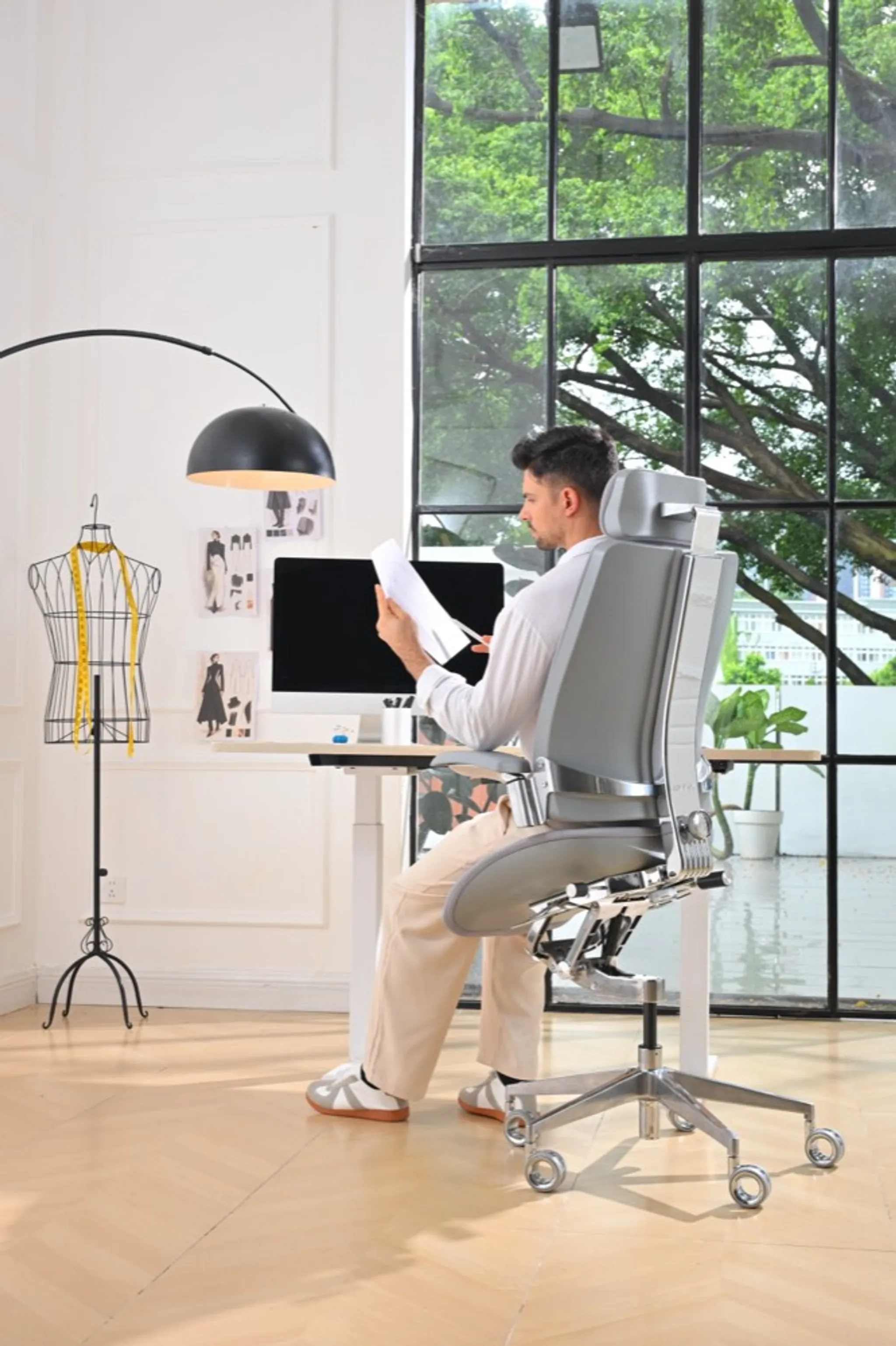
Tilt a seat 10 to 15 degrees forward and your lower back changes shape. Bridger's controlled comparison of seat angles (South African Journal of Physiotherapy, 1985) found that forward-sloping seats preserved the lumbar curve where flat and rearward-sloping seats flattened it. That single finding is the entire case for the forward-tilt chair. It is also why the standard ergonomic chair answers with a completely different bet: support instead of angle.
Both designs can improve your posture, and both carry a cost the spec sheet does not mention. Which one deserves your money depends less on features and more on how you actually move through a working day. Here is the comparison, posture by posture.
What is a forward-tilt chair, and what is it trying to fix?
A forward-tilt chair lets the front of the seat drop below the back, so the seat pan slopes down and away from you. That tilt opens the angle between your torso and your thighs. Instead of the roughly 90-degree angle a flat seat puts you in, your hips open toward 100 to 110 degrees.
Why does the angle matter? When your hips stay tight for hours, your pelvis tends to roll backward and your lower back flattens into a slouch. Keegan's radiographic studies (The Journal of Bone and Joint Surgery, 1953) pegged the angle between trunk and thigh where the lumbar curve survives best at roughly 135 degrees; at 90 degrees the pelvis swings rearward and the curve slumps flat. Forward-tilt seating chases that open angle directly. It is popular with people who lean in close to draw, write by hand, do detailed lab or dental work, or type at a desk that runs a touch high.
The catch is what a forward tilt does to the rest of your body. Point a seat downhill and gravity wants to slide you off the front edge. Many designs answer this by asking your legs and core to hold you in place, which is fine for a focused hour and tiring across a full day.
What is a standard ergonomic chair, and what does it do well?
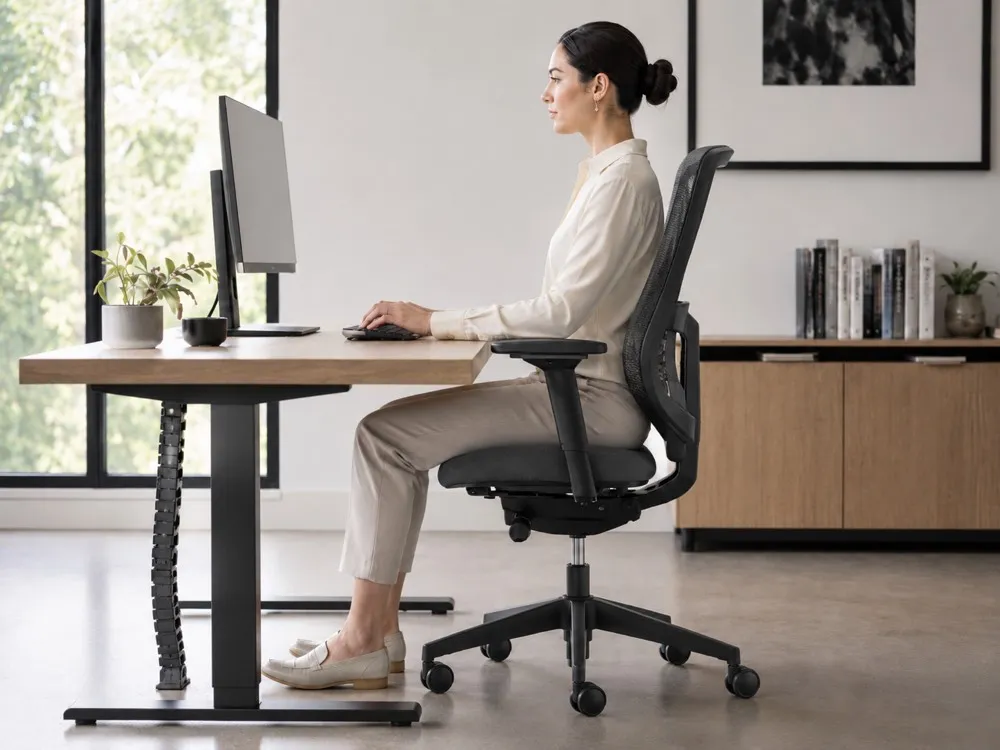
A standard ergonomic chair is the familiar task chair: a contoured backrest, adjustable lumbar support, a synchro-tilt that reclines the back, armrests, and seat-height and depth controls. Think of the well-known task chairs from Herman Miller, Steelcase, or Haworth. These are genuinely good tools, refined over decades.
The strength of an ergonomic chair is support you do not have to work for. The backrest catches your spine. The lumbar pad fills the gap behind your lower back. The recline lets you shift load off your discs when you read or take a call. For long stretches of mixed desk work, that constant support is why these chairs remain the default in most offices.
Where does a standard ergonomic chair quietly fail? Most are tuned for one comfortable position: a slightly reclined, well-supported seated posture. The moment you lean forward to focus, you leave the backrest behind. Your lumbar support no longer touches you. You are now perched on the front of a flat seat with your hips closing back toward that tight angle, and the chair is doing very little. Lower-back support in the upright, leaned-in working posture is the exact place many otherwise excellent chairs stop helping.
Forward-tilt chair vs standard ergonomic chair: side-by-side
| Factor | Forward-Tilt Chair | Standard Ergonomic Chair |
|---|---|---|
| Open hip angle for close work | Strong, this is its core purpose | Weak, the flat seat keeps the angle tight |
| Back and lumbar support | Limited, and lost when you lean in | Strong, contoured back plus adjustable lumbar |
| All-day comfort | Fair, legs and core do more work | Strong, support you do not have to hold |
| Reclined rest and load relief | Weak, tilt favors upright only | Strong, synchro recline offloads the spine |
| Encourages active movement | Good, keeps you upright and engaged | Fair, easy to settle into one static slump |
| Learning curve | Moderate, takes days to adjust | Low, feels familiar right away |
| Works with a taller desk | Good, suits leaning in | Fair, depends on the model |
| Best for | Focused, leaned-in tasks | Long mixed days of typing, reading, calls |
Which one is actually better for your posture?
Neither wins outright, because they answer different questions.
Choose a forward-tilt chair if most of your day is spent leaned in and focused, if your desk runs slightly high, and if a tight hip angle is what tips you into slouching. The open angle is a real ergonomic benefit, and being nudged to stay upright and active is good for people who otherwise collapse into a static slump. Be realistic about stamina, though. If your legs are quietly bracing you off a downhill seat all day, the fatigue will find you by mid-afternoon.
A standard ergonomic chair is the better pick if your day is a mix of typing, reading, and calls, and if you value support you never have to think about. The backrest and lumbar carry you, and the recline gives your spine a genuine rest that a forward-tilt seat cannot. Accept the trade-off: the chair is at its best when you are leaned back into it, and it does the least for you in the leaned-in focus posture where a lot of real work happens.
Most people are not one or the other. You lean in to concentrate, then lean back to think, then lean in again. That is where both designs show their seams. A forward-tilt chair gives you the focus posture but drops the rest. A standard ergonomic chair gives you the rest but fights the focus posture. If you have circled this comparison a few times, it is usually because you want both and no single traditional chair is offering it.
For a broader map of every posture-seating option and the trade-offs each carries, see our guide to alternative seating for better posture. If you want to go deeper on the tilt idea specifically, read our closer look at whether forward-tilt chairs are good for your back, and for the shopping shortlist there is the best forward-tilt chair alternative for all-day desk work. It also helps to compare the standing-desk chair against a traditional task chair, since the same tension shows up there.
What most reviews leave out
The tension between these two chairs is not a flaw in either one. It is baked into the physics of a fixed seat. A flat seat cannot open your hips. A downhill seat cannot support your back when you settle. A recline cannot follow you forward. Each design picks a posture and optimizes it, and asks you to live with what happens in the others.
This is the single most common failure across posture seating in general: a product fixes one position and quietly fails the moment you shift. It is why so many people end up owning two or three partial chairs and swapping between them, never quite comfortable in any of them.
The chair that keeps the standing angle while you sit
Stand up for a moment and notice your hips: open well past 110 degrees, spine holding its natural curve without effort. That shape is what a forward-tilt seat is reaching for, and what a lumbar pad tries to fake from behind.
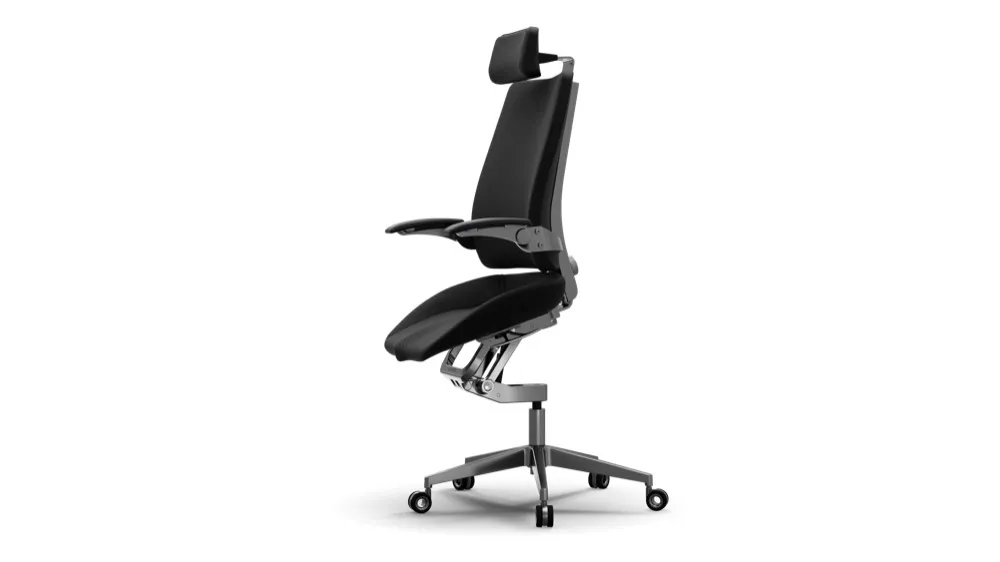
The Vision Chair takes the forward-tilt route and fixes its usual weakness. The seat angles up to 18 degrees forward of flat, so the pelvis tips forward and the curve returns on its own with nothing pressing into your back. Where a plain forward tilt then slides you off the front, the patent-pending T-Mech™ hinges the seat at the knee so it stays under your thighs as you move, and a bowl of dual-density foam cradles the pelvis the whole way.
The second difference is the backrest. On most forward-tilt chairs it is a separate setting you balance against the seat. Here it is linked to the seat and travels with it, so the open angle holds across the chair's range rather than only at the tilt you dialled in. Lean in to work and the chair does not shut you up.
The slope is also its own feedback. Perch too far forward and you slide; slump and it feels wrong within seconds. Rather than a correct position you have to remember, the comfortable position is the open one. That is what the Elevated Seating category means, and the mechanism earned a Best of NeoCon 2026 Innovation Award. One consequence worth planning for: the slope raises how high you sit, so it needs a desk that can rise to meet it.
Frequently asked questions
Is a forward-tilt chair better than a standard ergonomic chair for lower-back pain?
It depends on your day. Forward-tilt helps most when the pain comes from slouching into a tight hip angle during close, leaned-in work. A standard ergonomic chair helps most when you need constant lumbar support and reclined relief. If your pain shows up in the leaned-in posture, neither traditional design fully covers it.
Can I just tilt my current ergonomic chair forward?
Some ergonomic chairs offer a small forward seat-tilt setting, and it is worth trying. The limit is that a tilted flat seat still slopes you off the front and pulls your back away from the lumbar support, so you gain the open angle but lose the support the chair was built to give.
Do forward-tilt chairs work for a full eight-hour day?
For many people, not comfortably on their own. The open angle suits focused sessions, but keeping yourself planted on a downhill seat asks your legs and core to work quietly all day, which fatigues. They tend to fit task-based work better than a full day of mixed desk time.
Which is better for a standing or sit-stand desk setup?
Forward-tilt and perch-style seating pair better with a higher or sit-stand desk, since leaning in from a raised seat is their strength. A standard ergonomic chair is built for a fixed seated height. If you move between sitting and standing often, that fit matters more than the chair's other features.