
Buying Guide
The Best Standing Desk Chair Alternative: What Actually Lasts a Full Working Day
Lean stools quit after an hour. Compare standing desk chair alternatives, from wobble stools to task chairs, and find the one seat that lasts a full day.
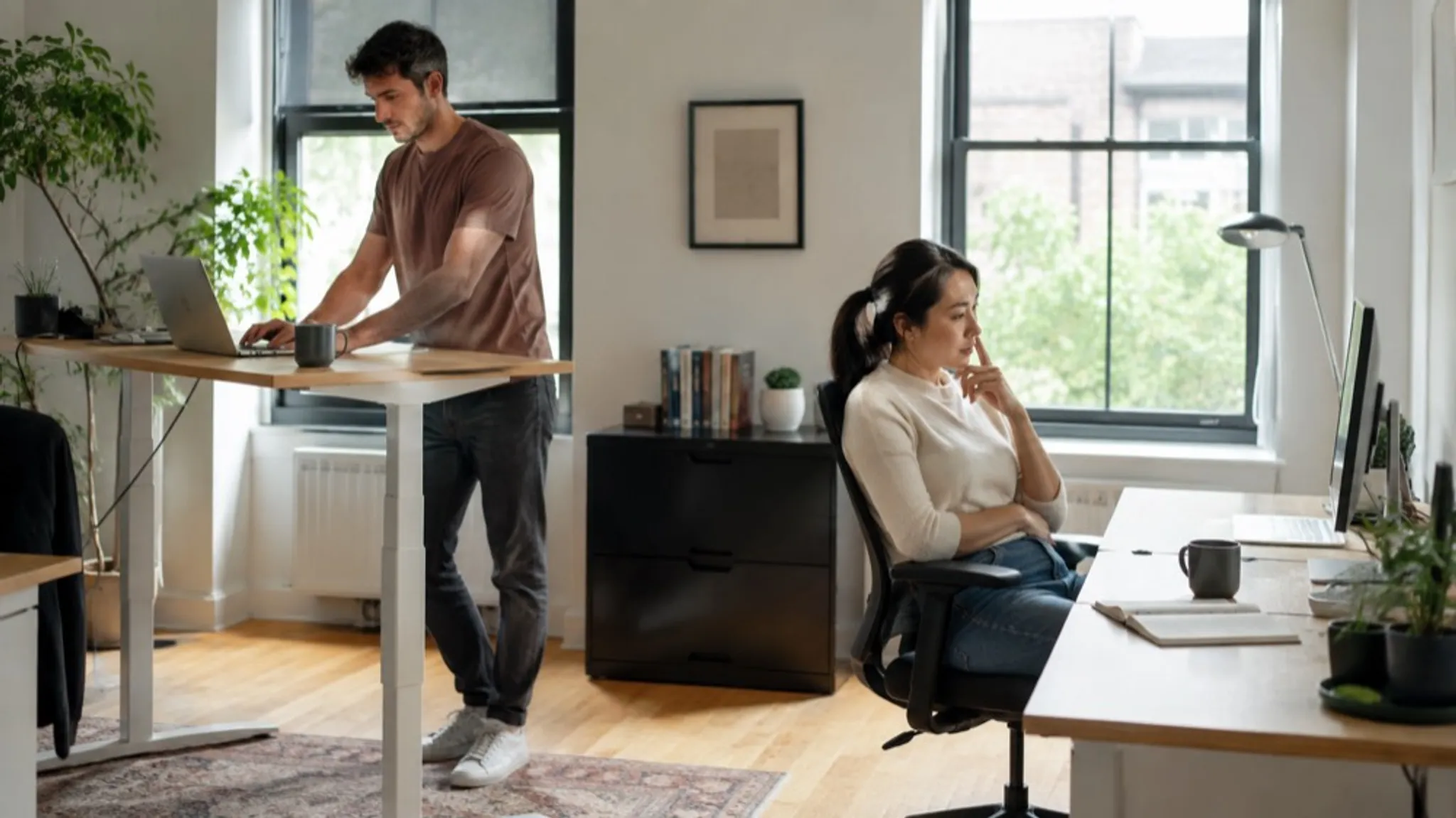
Most lean stools get about a month of daily use. Then they migrate to a corner of the room, and their owners drift back to whatever chair they were trying to escape. Not because the stool is badly made, but because it was asked to do a job it was never built for: carrying a person through eight hours of focused work.
So the real question is not which lean stool to buy. It is what to sit on when the day runs long. Below you will find the main options ranked, the standing desk chair itself included, so you can match the seat to the way you actually work. A lean stool next to a raised desk is a genuinely good tool for the right job. The point is knowing which job is yours.
What a standing desk chair does well
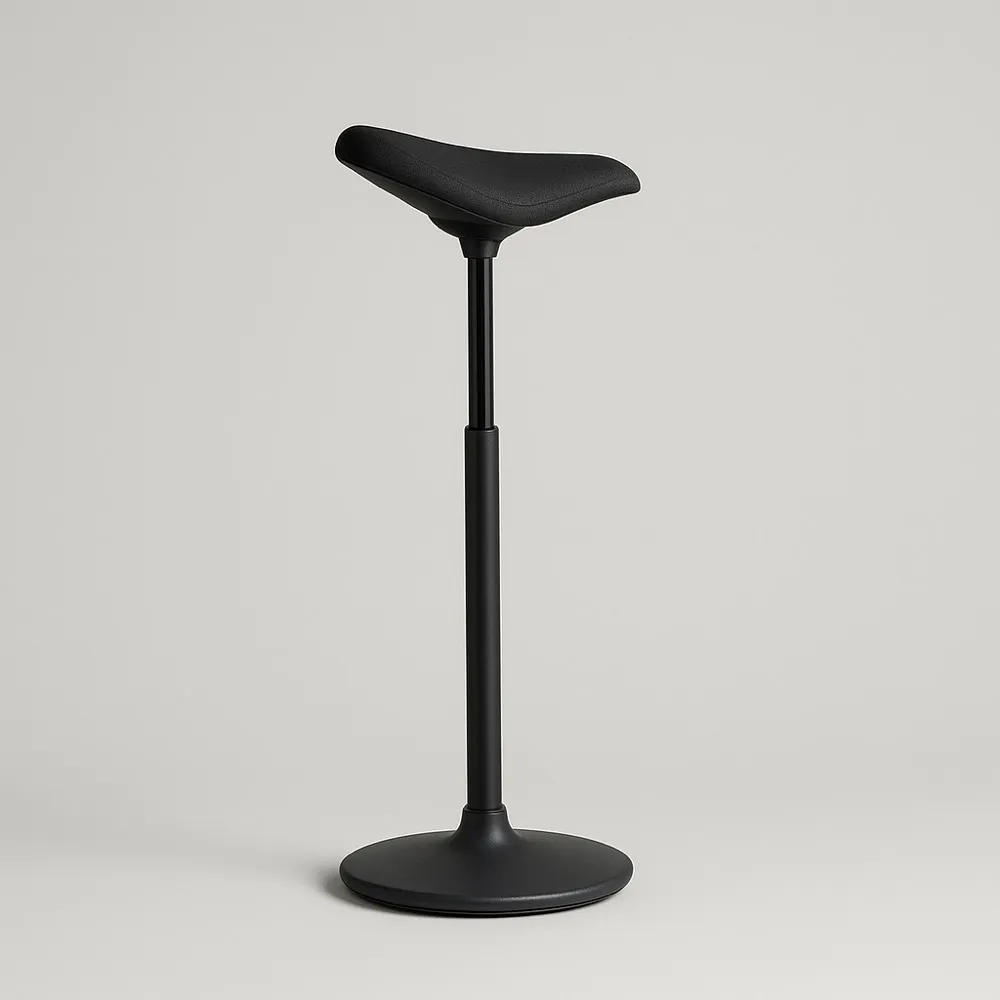
A standing desk chair, also called a lean or perch stool, holds you in a half-standing position. The seat is high and often angled forward. You rest against it rather than sit fully into it. That keeps your hips open, encourages small shifts of weight, and makes the jump between sitting and standing feel natural.
There is real ergonomic thinking behind that stance. Mandal argued in "The Seated Man" (Applied Ergonomics, 1981) that sitting at 90 degrees owes more to furniture design than to anatomy, and that the working posture should move toward half-standing, hips open at roughly 120 to 135 degrees. A perch stool is one of the simplest ways to get there. You raise the desk, perch, drop the desk, and sit. No wrestling a heavy chair out of the way.
The trouble starts when the day gets long. With no backrest to fall into, your core and lower back do the work of holding you up. Once you tire, you slouch, and the posture benefit quietly disappears. A lean stool is a companion to standing, not a replacement for a supportive chair. We go deeper in our look at whether standing desk chairs are good for your back.
How to choose: match the seat to your day
Before ranking anything, ask yourself one question. How many hours do you sit versus stand on a normal day?
- Mostly standing, short sits: a lean stool is likely all you need.
- A real mix of sitting and standing: you want something that supports you when seated and does not fight you when you stand.
- Mostly seated, long focused blocks: you need a chair that supports your back and thighs for hours, not a perch.
Most desk workers fall into the second and third groups and buy a lean stool hoping it covers the first. That mismatch is why the stool ends up in a corner within a month.
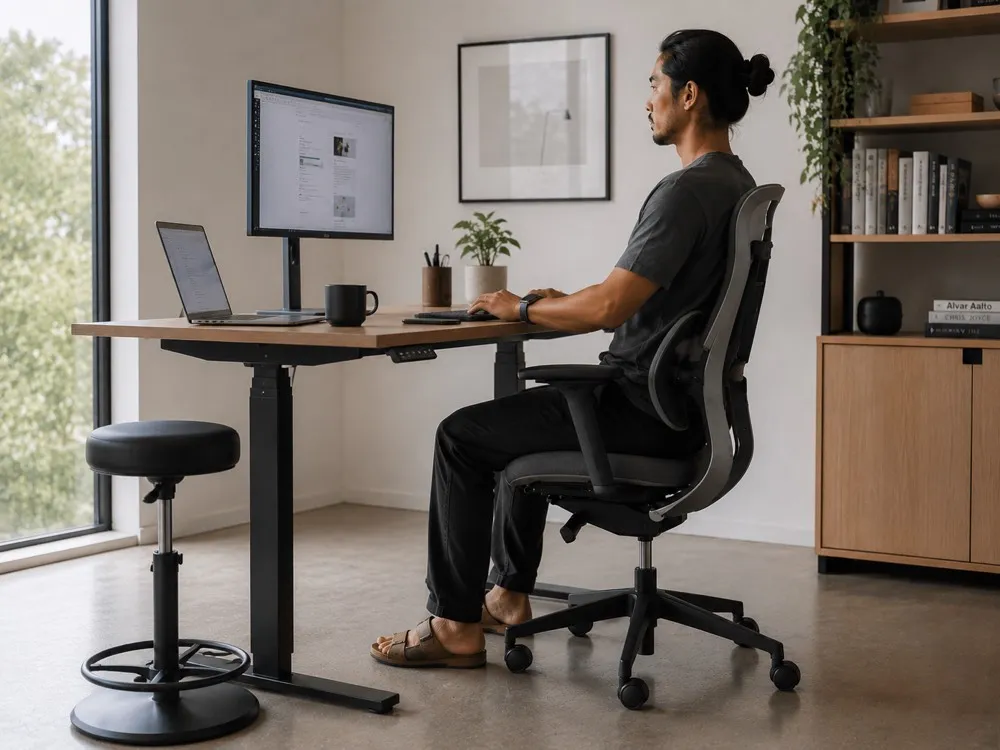
Four options, ranked by the day in front of you
1. A lean stool or standing desk chair (keep it, for the right job)
For short perching next to a raised desk, this is still the right tool. It is light, cheap, and easy to move. Buy one that adjusts high enough for your desk and has a wide, slightly padded seat so the edge does not dig in. The forward slope is not a gimmick either: Bridger's controlled study of forward-sloping seats (South African Journal of Physiotherapy, 1985) found seats tilted 10 to 15 degrees forward preserved the lumbar curve where flat seats flattened it.
Who it is for: people who stand for most of the day and only sit briefly, or who want a second seat purely for perching.
The trade-off: no back support, fatiguing over long stretches, easy to slouch on once you are tired. It is a supplement, not a primary chair.
2. A quality ergonomic task chair
If you spend most of the day seated, a well-made task chair from a maker like Herman Miller, Steelcase, or Haworth will serve you far better than a stool. These chairs support one good seated posture with real lumbar support, adjustable arms, and a seat that holds up for hours. They are proven, comfortable, and widely respected for good reason.
Their limit is that they are built around a single primary posture. They support you beautifully when you sit back to work, but they do not bridge sitting and standing, and they do not keep the seat in contact with your thighs as you shift forward to lean into a screen. When you perch on the front edge, you lose most of the seat and all of the back support. For a fuller comparison, see our breakdown of a standing desk chair versus a traditional task chair.
Who it is for: anyone whose day is mostly seated and who wants dependable, all-day comfort in one trusted posture.
The trade-off: excellent at one static posture, not designed to move with you between reclined and forward-elevated positions.
3. An active wobble stool
A wobble or perch stool sits between the two above. It encourages constant micro-movement and pairs well with a standing desk for short bursts. It keeps you engaged and moving in a way a fixed stool does not.
It shares the lean stool's core weakness though. No back support means fatigue on long days, and it is easy to slouch once you tire. If this is your direction, our guide to the best active wobble stool alternative and our closer look at whether wobble stools are good for your back go deeper.
Who it is for: people who want movement and already stand often, and who sit in short active bursts rather than long blocks.
The trade-off: no back or thigh support over long hours; the novelty of the wobble can wear off.
4. The Vision Chair
Here is the engineering problem every option above works around: a forward-tilted seat normally slides you off its front edge. A perch stool answers by making your legs do the bracing. A task chair answers by keeping the seat flat and giving up the open angle.
The patent-pending T-Mech™ takes a third route. The seat angles up to 18 degrees forward of flat, which tips the pelvis forward and opens the hip angle to roughly 115 to 125 degrees, and a knee-pivot linkage sweeps the seat around your knee so your thighs stay supported instead of your legs bracing. The backrest is linked to that seat and moves with it, so the angle holds across the chair's range rather than only at the setting you dialled in. A foam bowl with two densities cradles the pelvis, and the J-Bar sets seat and backrest angle.
The slope also keeps you informed. Perch too far forward and you begin to slide; slump and the position feels wrong within seconds, because the seat is no longer under you the way it was. The good position is the comfortable one, so you settle into it rather than maintaining it. That is the stance a lean stool promises, with the support a stool cannot give, and it earned the Best of NeoCon 2026 Innovation Award.
Who it is for: people who want the forward, elevated posture a lean stool encourages, but who also need real support for full-day desk work, without owning two separate seats.
The trade-off: it sits in the premium, professional tier, so it is a considered purchase rather than an impulse buy. It is one chair meant to do the job you were trying to split across a stool and a task chair, and 612 Kickstarter backers put over $561,000 behind that idea in about a month.
So which is the best standing desk chair alternative?
There is no single winner, because the answer depends on your day. If you truly stand most of the time, keep a good lean or wobble stool for the short sits. If you are mostly seated in one posture, a quality ergonomic task chair is the safe, proven choice.
If what you actually wanted from a standing desk chair was the open-hip, forward-leaning feel without the fatigue, and you need it to last a full working day, that is the gap the Vision Chair was built to close. It is the only option here that keeps supporting you as you move rather than making you choose one posture and live in it.
Frequently asked questions
Can a standing desk chair replace a normal office chair?
For most people, no. A lean stool is a companion to a standing desk, good for short perching, but it lacks the back and thigh support needed for long seated work. Pair it with a supportive chair, or choose seating that handles both.
Is a lean stool bad for your back?
Not inherently. Used in short bursts it keeps your hips open and encourages movement. The problem is long hours without back support, which leads to slouching and lower-back fatigue once you tire.
What is the best chair for a sit-stand desk if I sit most of the day?
If your day is mostly seated, a quality ergonomic task chair or the Vision Chair will serve you far better than a stool. The Vision Chair adds the ability to move into a forward, elevated posture without losing support, which suits sit-stand workflows.
Do I need to spend a lot to get all-day support?
Not always. A good task chair covers most seated needs. Spending more makes sense when you want one seat that moves with you between postures instead of buying a stool and a chair separately. Want to see how the T-Mech keeps thigh and pelvic support through every posture? Read the complete guide to alternative seating, or explore how the Vision Chair works at the Vision Chair. If you are reading this you probably already own the other half of the setup. An angled seat raises how high you sit, so it needs a desk that can rise to meet it. Anyone shopping for a standing desk chair already has that desk, which makes this the one audience for whom the requirement costs nothing.