
Buying Guide
Are Ergonomic Drafting Stools Good for Your Back? What the High Perch Fixes and What It Leaves Out
Drafting stools open your hips and fit tall desks but offer little back support. Where they help, when they fall short, and what carries a full workday.
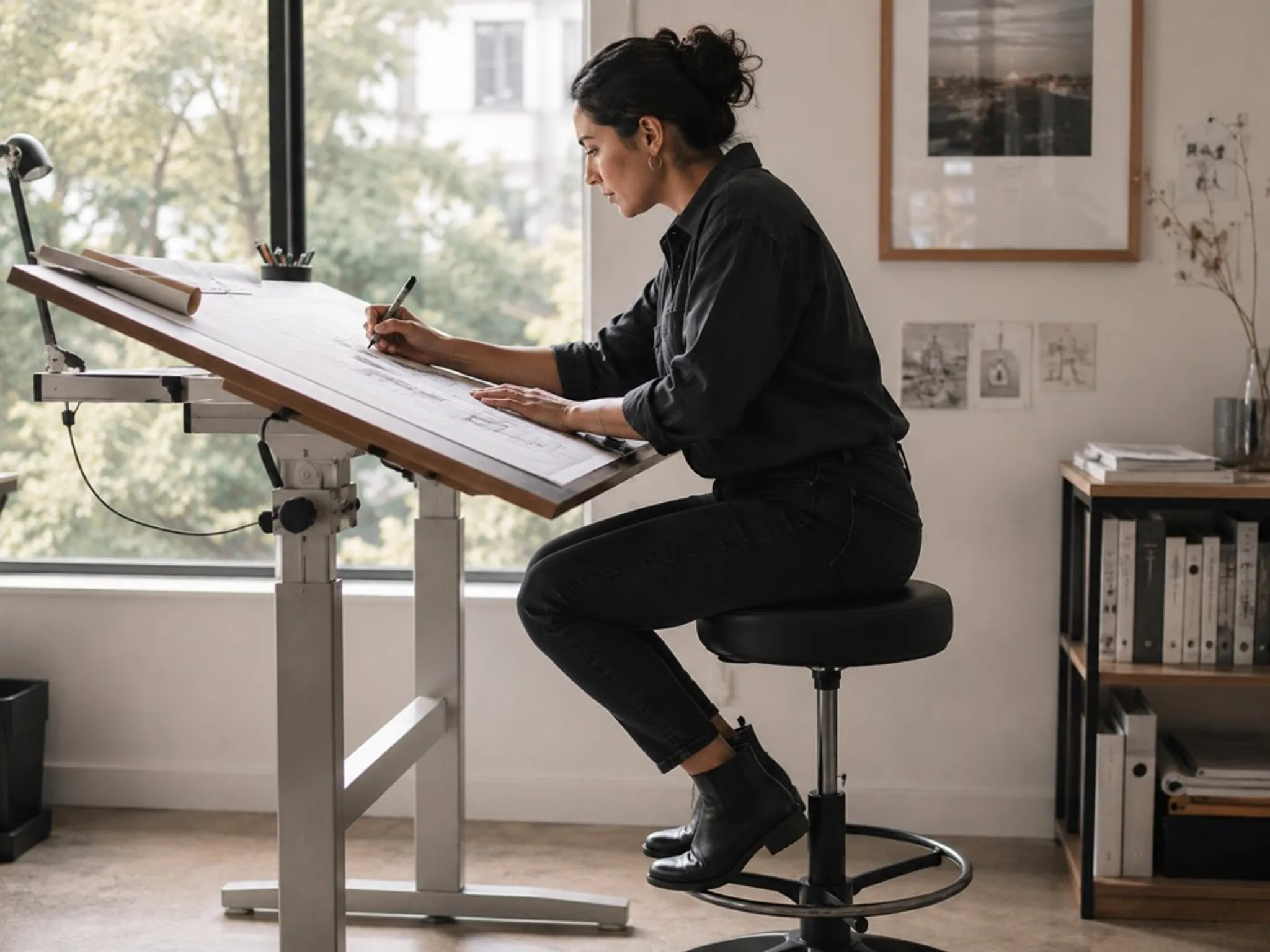
If your desk sits higher than a standard 29 inches, a normal office chair leaves your feet dangling and your arms reaching up. That is the exact problem a drafting stool was made to fix. The taller cylinder, the footring, and the compact seat let you sit at a raised bench, a counter, or a standing desk in its lowered mode.
Whether that same design is good for your back over a full working week depends on what you ask of it. A drafting stool is a strong perch and a weak all-day chair. The sections below cover the mechanics behind that split, the people the stool fits, the point where the comfort fades, and the seating that carries a longer day.
What does an ergonomic drafting stool actually do to your posture?
A drafting stool raises your whole sitting position. When the seat is higher and you drop your feet to a footring, your hips open past the cramped 90 degrees a low chair forces on you. A more open hip angle tends to tilt the pelvis forward a little, which lets the lower spine settle into its natural inward curve instead of rolling back into a slouch.
That is the same mechanism behind saddle stools and perch stools, and it is a real benefit. Keegan's radiographic studies (The Journal of Bone and Joint Surgery, 1953) located the ideal opening between trunk and thigh, the one that preserves the lumbar curve, at roughly 135 degrees; at 90 degrees the pelvis leans back and the low-back curve straightens. A drafting stool nudges you toward the better shape without any effort on your part.
The catch is that a drafting stool is mostly a height solution, not a support solution. It gets your body to the right elevation for a tall desk. It does far less to hold your body there once your muscles get tired.
Who gets real value from a drafting stool?
Some people are a natural fit for this kind of seating.
- Standing-desk users who want to perch instead of stand for part of the day. A drafting stool at the desk's lower height lets you lean-sit without dropping all the way into a full chair.
- People at tall or fixed-height benches such as lab stations, workshops, reception counters, art tables, and drafting boards. This is the stool's original home.
- Anyone doing reach-heavy work like sketching, model-making, or lab tasks, where you shift position often and lean into the work.
- Movers, not settlers. If you are the kind of person who is up and down all day, a stool that is easy to get on and off suits your rhythm.
For these uses, a drafting stool can be a real win for your back, because it keeps you higher, more open at the hip, and more mobile than a slumped low chair would.
How does the stool hold up past the first week?
The first days often feel great. You sit taller, your back feels more open, and the novelty of an active perch is pleasant. This is where a lot of glowing early reviews come from.
By week two or three, the picture sharpens. Most drafting stools give you either no backrest or a small one that only meets the lowest part of your back. That is fine while your core is fresh. It stops being fine in the afternoon of a long day, when the muscles that were holding you upright get tired and quietly hand the job to your spine and ligaments. You start to slump, and a slump on a backless stool has nothing to catch it. Nachemson's disc-pressure measurements (Spine, 1981) found unsupported sitting drives lumbar disc load about 40 percent past standing levels, which is exactly the position a tired sloucher ends up in.
The seat is another slow reveal. Drafting stools tend toward small, firm pads. On a short reach task that is a non-issue. Over four unbroken hours it can turn into sit-bone and tailbone pressure. A supportive foam seat matters more than most buyers expect, and a lot of budget stools skimp there.
None of this makes a drafting stool a bad product. It makes it a stool doing exactly what a stool is for. The trouble only starts when you treat a perching tool as your primary all-day chair.
Where do drafting stools help your back, and where do they fall short?
| Factor | Where a drafting stool helps | The trade-off |
|---|---|---|
| Hip angle and spine | Raises you and opens the hips, which encourages a neutral lower back | The benefit depends on you staying active; it fades as you tire |
| Height fit | Made for tall desks, benches, and lowered standing desks | Overkill and often too high for a standard desk |
| Movement | Easy to get on and off, good for reach-heavy tasks | Rewards fidgeting, not settled focus work |
| Back support | Encourages self-supported upright sitting | Little or no lumbar support in the upright working posture |
| Long-day comfort | Fine for short and medium sessions | Small firm seats can cause sit-bone pressure over hours |
| Learning curve | Gentler than a saddle seat | You still have to hold yourself up, which fatigues you |
The pattern in that table is the pattern behind almost all posture seating: a device fixes one position well and then fails you the moment you shift or tire. A drafting stool nails the high perch and then leaves you unsupported when you need to settle in and grind through a long block of focused work.
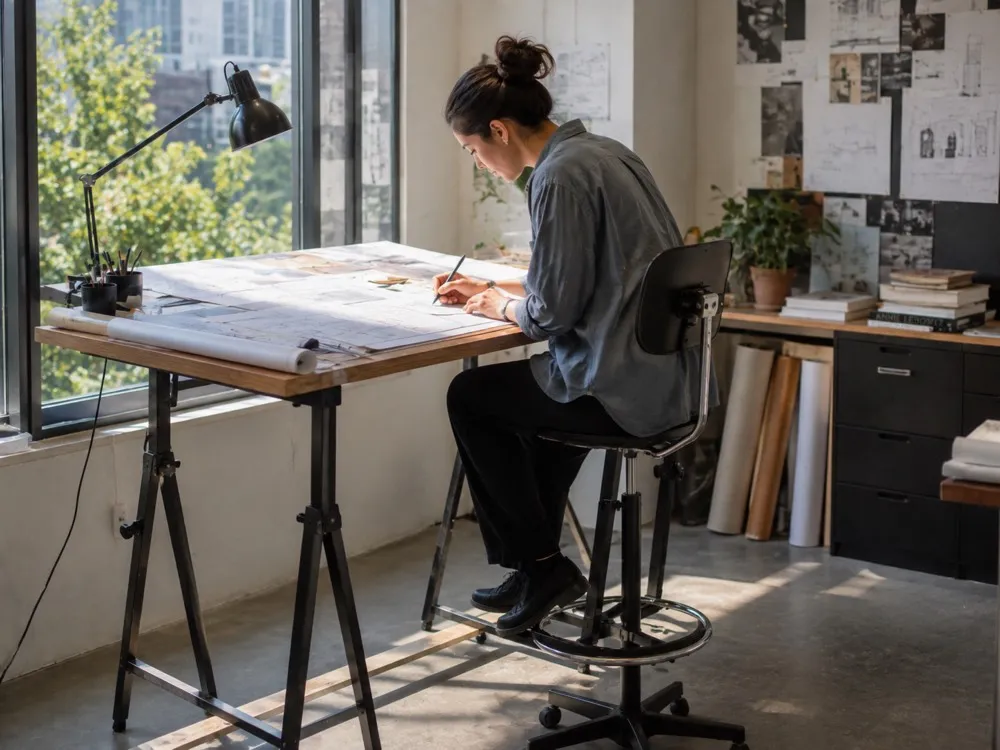
Are drafting stools better than a saddle chair or a standing-desk stool?
They are close cousins, and the differences are small but real. A saddle seat tips the pelvis forward more aggressively and is popular with dentists and hygienists, at the cost of a steeper acclimation and possible sit-bone or perineal pressure. A drafting stool is easier to get used to but usually opens the hips less. If you are weighing those two directly, the ergonomic drafting stool vs saddle chair comparison breaks down which one wins for each use case.
A lean or perch stool for a standing desk overlaps heavily with a drafting stool. Both are perching tools, not primary chairs, and both share the same limit: they are companions to standing, not a full-day seat.
So should you buy one for back pain?
Buy a drafting stool if your real need is height and perching. If you have a tall bench or a standing desk and you want to sit-lean for stretches of the day while staying mobile, it is a sensible tool that does its job.
Do not buy a drafting stool expecting it to be a full-day, back-saving chair. It does not have the lumbar support or the seat comfort to carry you through eight hours, and no amount of good intentions will make an unsupported perch hold you up once your core is spent. If full-day desk work is the actual job, look at seating built to support you continuously rather than only while you concentrate on your own posture. The best drafting stool alternatives for all-day work are ranked on exactly that merit.
Frequently asked questions
Are drafting stools good for lower back pain?
They can help by raising you and opening the hip angle, which reduces the slouch a low chair forces. The limit is that most drafting stools offer little lower-back support in the upright working posture, so the relief depends on your own muscles holding the position. That works for short sessions and fades over a full day.
Can you use a drafting stool as your only office chair?
For most people, no. A drafting stool is a good perch for a high or standing desk and short-to-medium tasks. As a sole, all-day chair it usually falls short on backrest support and seat comfort, and it rewards slouching once you tire.
Do drafting stools work with a normal-height desk?
Usually not well. Drafting stools are built tall for benches, counters, and standing desks. At a standard 29-inch desk they often sit too high, which leaves your arms reaching down and undoes the ergonomic benefit.
How long can you comfortably sit on a drafting stool?
That varies by person and seat quality, but the common pattern is comfort for short and medium sessions and rising sit-bone pressure and fatigue over several unbroken hours. Frequent standing and movement extend the comfortable window.
What changes when the angle never closes
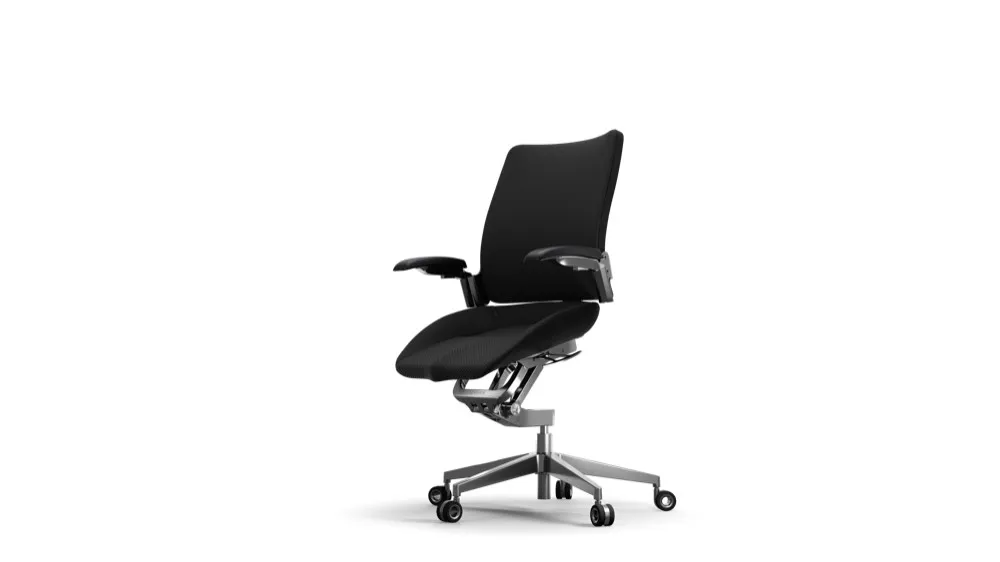
Every stool on this page opens the hip angle in one posture and gives it up in the rest. A drafting stool opens your hips on the high perch, then loses the benefit the moment your core tires and you slump. The Vision Chair's premise is different: the chair itself does not close the angle as you move, and the open position is the comfortable one, so you tend to stay in it without trying.
A drafting stool opens the hip angle by raising you and letting your legs take the difference. The Vision Chair opens it by sloping the seat instead, up to 18 degrees forward of flat, which tips the pelvis forward and lets the lumbar curve return without a pad pushing into your back.
The patent-pending T-Mech™ traces an arc with the knee as its pivot, so your thighs stay supported edge to edge rather than your legs carrying the perch. The backrest is linked to the seat and moves with it, so the open angle holds across the range rather than lasting only as long as your endurance does. The seat's dual-density bowl cradles the pelvis the whole way.
Both approaches raise how high you sit, the stool by lifting the whole seat and the Vision Chair by sloping it, so both want a desk that can rise to match; if you were already shopping for a tall stool you have accepted that. The difference is that here there is a backrest behind you when your legs are finished. The Vision Chair took home the Best of NeoCon 2026 Innovation Award, and you can see how it works at the Vision Chair.
Both approaches share a requirement. A drafting stool raises you and needs a tall desk; an angled seat raises you too, and needs a desk that can rise to meet it. If your desk height is fixed at the usual 73cm, that limits both options before the seat design matters at all.
For the full map of posture seating and how these options compare, start with our complete guide to alternative seating.