
Guide
Anterior Pelvic Tilt From Sitting: What May Contribute and What to Consider
Sitting at 90 degrees shortens the hip flexors and quiets the glutes, training anterior pelvic tilt in. Self-checks, stretches, and desk changes that help.
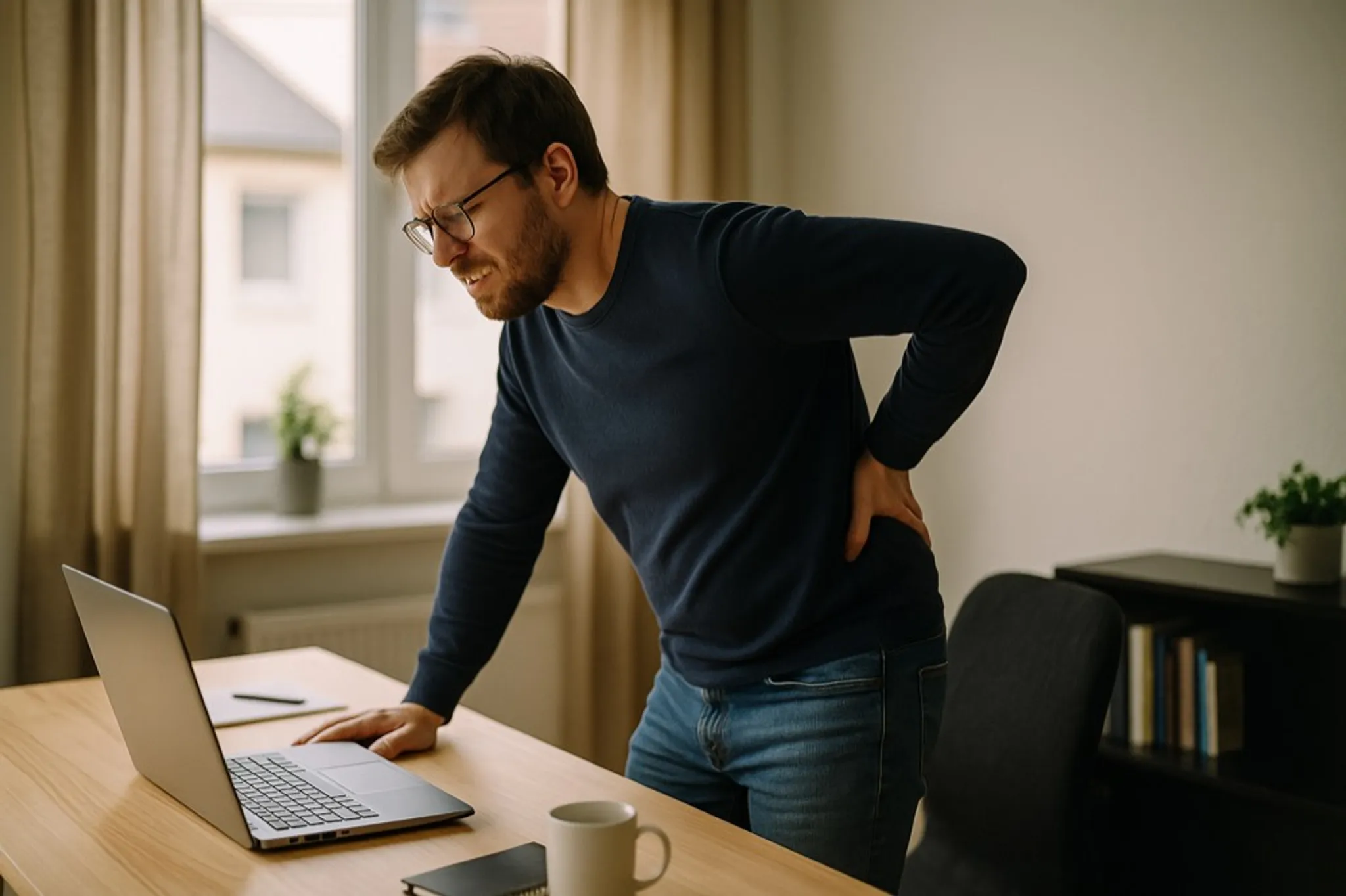
Stand sideways in front of a mirror after a long desk day and you may see a specific silhouette: lower back arched harder than usual, belly pushed forward, glutes sitting flat. That shape has a name, anterior pelvic tilt, and for desk workers the main thing training it in is the position you hold eight hours a day: hips closed to roughly 90 degrees.
What follows covers the mechanics in plain terms. What the tilt actually is, why a full day in a chair quietly encourages it, how to check yourself for it, and the stretches, strengthening, and desk habits that many people find help. No miracle fixes, just the mechanics and what you can do about them.
What is anterior pelvic tilt, exactly?
Your pelvis is not a fixed block. It rotates, and small changes in its angle change the whole chain above and below it. Anterior pelvic tilt is when the front, or top, of the pelvis rotates forward and down while the back rises. Picture a bowl of water tipping so it spills out the front.
When that happens, the lower back is pulled into a deeper arch than it wants to hold all day. The belly tends to push out, the ribs flare up, and the glutes look and feel flatter because they are switched off. None of this means anything is broken. A slight natural curve in the lower back is normal and healthy. Anterior pelvic tilt is the exaggerated version that starts to feel like tension, tightness, or a low ache.
It is worth being clear here: a chair, a stretch, or an exercise does not treat or cure a medical condition. Posture is a habit and a set of muscle balances you can influence over time, not a switch you flip.
How does sitting all day cause anterior pelvic tilt?
The mechanics are a little counterintuitive, so take them one piece at a time.
When you sit in a standard chair, your hips are bent to roughly 90 degrees for hours at a stretch. The muscles that run across the front of your hip, the hip flexors, sit in a shortened position the entire time. Muscles adapt to the position you keep them in. Keep the hip flexors short for years and they get comfortable there, tugging the front of your pelvis downward even when you stand up.
Meanwhile the muscles that should oppose that pull, mainly the glutes and the deep core, do almost nothing while you sit. They go quiet. Over months and years the front-of-hip tightness and the back-of-hip weakness combine, and the pelvis settles into that forward-tipped position as its new default.
There is a second wrinkle. Many people also slouch into a rounded lower back while seated, which is the opposite tilt. Keegan's radiographic analysis (The Journal of Bone and Joint Surgery, 1953) showed why: at a 90-degree trunk-thigh angle the pelvis rotates back and the lumbar curve flattens, and he put the angle that best preserves the curve at roughly 135 degrees. So sitting can pull you two ways at different moments. What matters is that prolonged sitting weakens the muscles that hold a neutral pelvis and tightens the ones that distort it. The chair is not the whole story, but it is the environment where the imbalance is trained in, day after day. Mandal made the sharper point decades ago (Applied Ergonomics, 1981): the 90-degree sitting posture is a product of furniture design, not human anatomy.
How can you tell if you have anterior pelvic tilt?
You do not need a lab. A few plain self-checks give you a decent read. None of these is a diagnosis, and body shapes vary, so treat them as signals rather than a verdict.
| Sign | What you might notice |
|---|---|
| Lower-back arch | A pronounced curve in the small of your back, even when relaxed |
| Belly forward | Your stomach appears to push forward more than your body fat alone explains |
| Rib flare | The bottom of your ribcage lifts and juts out at the front |
| Standing ache | A tired, tight, or aching lower back after standing still for a while |
| Tight hip fronts | Stiffness across the front of the hips, especially after a long sitting stretch |
| Flat, quiet glutes | Glutes that feel like they do not switch on easily during walking or stairs |
A common at-home test is to stand with your back against a wall, heels a few inches out, and slide a hand into the gap behind your lower back. A small gap is normal. A gap large enough for your whole flat hand to pass through easily, or an arch that feels hard to reduce, points toward more tilt.
What actually helps anterior pelvic tilt from sitting?
The pattern that trains it in is the pattern you reverse: loosen what is tight, wake up what is weak, and stop holding one position for hours. Below are the commonly recommended pieces. Start gently, and if anything sharpens pain rather than easing it, stop and check with a professional.
Move more often. The single most underrated fix is simply not staying at 90 degrees for hours. Stand, walk, and change position every 30 to 45 minutes. Even a minute of walking resets the hip flexors and gives the glutes a job to do.
Stretch the hip flexors. These are the muscles doing the pulling. A half-kneeling hip-flexor stretch, where you drop one knee to the floor and gently push the hips forward while keeping the back tall, is the classic. There is a fuller walkthrough on our tight hip flexors from sitting guide.
Wake up and strengthen the glutes. Glute bridges, where you lie on your back and drive your hips up by squeezing your backside, are the go-to. Strong glutes are the direct counterweight to a forward-tipped pelvis.
Engage the deep core. Gentle work like dead bugs or a light plank teaches the front of your trunk to hold the pelvis in a more neutral spot. The goal is control, not crunches.
For a desk-friendly routine that combines these into something you can do without leaving your workspace, see our anterior pelvic tilt exercises you can do at your desk.
One thing to be clear about on results: these movements can change how your pelvis sits, but it is slow work measured in weeks and months, and it competes with the hours you spend seated. That is the real catch, and we will come back to it.
When should you see a professional?
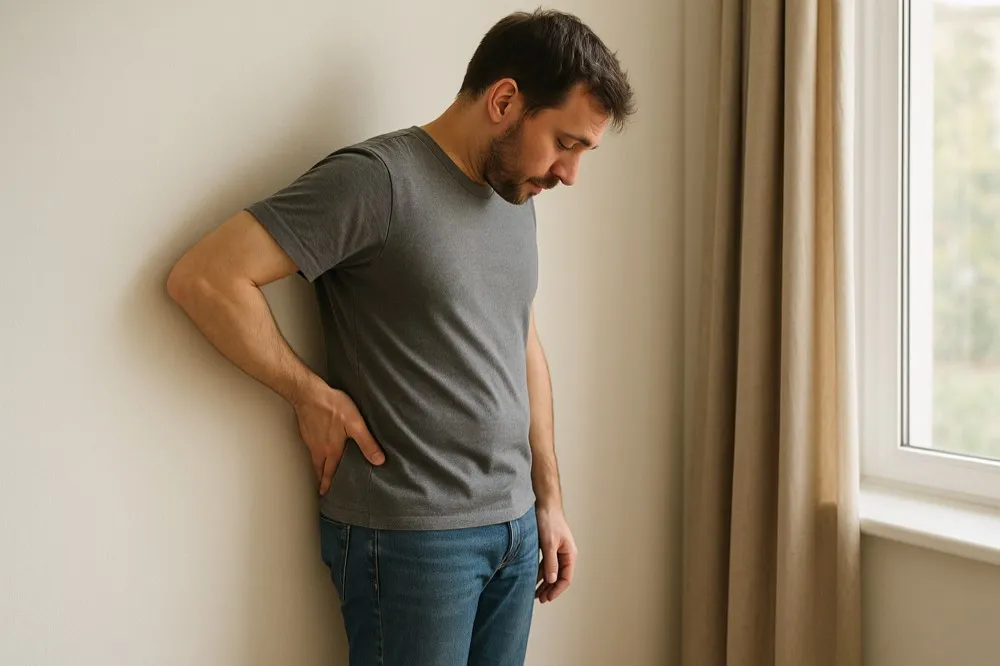
Posture work is generally safe, but pain is information, and some signals mean you should get a qualified opinion rather than self-treating. See a physiotherapist, chiropractor, or doctor if you have pain that travels down your leg, numbness or tingling, weakness in a leg or foot, pain that wakes you at night, pain after a fall or injury, or discomfort that lasts more than a few weeks despite sensible changes. A professional can look at your specific body, rule out anything that needs real attention, and tailor a plan far better than any article can. This page is general education, not medical advice.
Why does your chair keep undoing the work?
This is the part most posture guides skip. You can stretch your hip flexors every morning and train your glutes three times a week, then spend the next eight hours held at the exact angle that built the tilt in the first place. The stretches get minutes. The chair gets hours.
Changing the environment ends that tug-of-war. The Vision Chair, the chair Levitask built to create the Elevated Seating category, approaches it from the seat rather than the backrest. The seat angles up to 18 degrees forward of flat, which tips the pelvis forward, and because the backrest is linked to the seat and travels with it, the hip angle stays open between roughly 115 and 125 degrees across the chair's range. Its patent-pending T-Mech™ pivots the seat around the knee, so your thighs and pelvis stay supported the whole way. One practical note: the slope raises how high you sit, so it pairs with a desk that can rise to match. The position that trains the tilt in stops being the easy one to fall into, because on a sloped seat a rolled-back pelvis feels wrong almost immediately. A chair does not treat or fix anterior pelvic tilt. What it can do is stop working against the stretching and strengthening you are already doing, so the progress has somewhere to stick.
Worth knowing before you change furniture: the forward seat angle raises your seated height, so this approach assumes a height-adjustable desk. A fixed desk undercuts it.
If you want the bigger picture on posture at a desk, start with our how to fix your posture field guide, and if sitting is also giving you a low ache, our lower back pain from sitting guide covers the related mechanics. You can also browse the full alternative seating guide to see how different chair concepts handle the hip angle.
Frequently asked questions
Can sitting really cause anterior pelvic tilt?
Prolonged sitting is a common contributor rather than the sole cause. Holding the hips at 90 degrees for hours keeps the hip flexors short while the glutes and core stay switched off, and that imbalance encourages the pelvis to settle into a forward tilt over time. Genetics, activity levels, and other habits play a role too.
How long does it take to improve anterior pelvic tilt?
There is no fixed timeline, and anyone promising one is guessing. Because it is a muscle-balance and habit pattern built over years, most people think in terms of weeks and months of consistent stretching, strengthening, and movement, not days. Reducing how long you sit in a closed hip angle tends to speed things along.
Will a special chair fix my anterior pelvic tilt?
No chair treats or fixes a postural pattern on its own, and any product that claims to should be treated with caution. A chair that supports a more open hip angle may help by keeping your hip flexors from parking in their shortest position all day, which supports the work your stretches and exercises are doing. It is a helpful environment, not a cure.
Is anterior pelvic tilt the same as lower back pain?
Not the same thing, though they often travel together. Anterior pelvic tilt is a position of the pelvis; lower back pain is a symptom that can have many causes. Some people with noticeable tilt have no pain at all. If you do have pain, especially pain down the leg, numbness, or weakness, see a qualified professional.